others
What Is Opium? History, Effects, Uses, and Risks
Aug
What Is Opium?
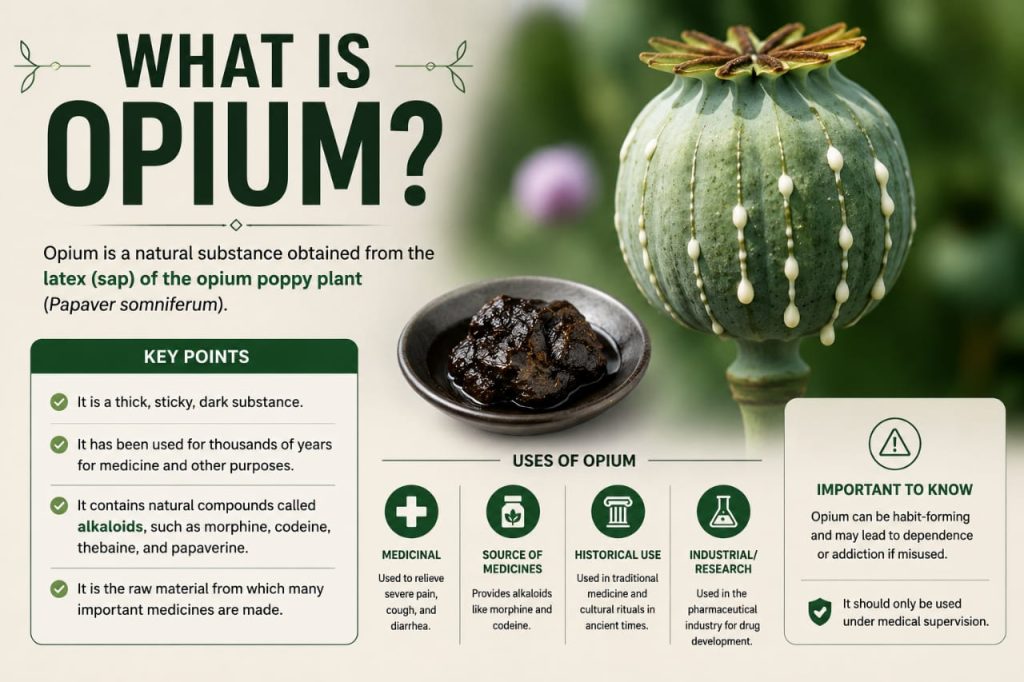
Opium is a naturally occurring substance produced from the dried latex of the opium poppy, Papaver somniferum. It contains several naturally occurring alkaloids, including morphine, codeine, thebaine, papaverine, and noscapine. Morphine is the principal opioid alkaloid in the plant-derived material and is responsible for much of its pain-relieving and sedating activity.
The substance has been used medicinally for thousands of years, particularly for pain and other conditions. However, its opioid compounds can also cause tolerance, physical dependence, opioid use disorder, respiratory depression, and potentially fatal overdose.
Readers interested in learning about other psychoactive substances can explore the Psychedelics section on Organic Shrooms Canada.
What Is Opium Made From and Where Does It Come From?
The substance comes from the opium poppy (Papaver somniferum). More specifically, it is the dried latex obtained from the plant’s unripe seed capsule.
This latex is a complex mixture rather than a single chemical compound. Its principal alkaloids include morphine, codeine, thebaine, papaverine, and noscapine. The precise composition can vary according to the poppy variety and growing conditions.
It is also important to distinguish food-grade poppy seeds from the latex produced by the plant. Mature seeds do not naturally contain the same latex found in the unripe capsule, although contamination with opioid alkaloids can occur during harvesting or processing.
A Brief History
The history of this poppy-derived substance stretches back thousands of years. Ancient civilizations used preparations from the plant for medicinal purposes, including pain relief and sedation.
During the 19th century, it became increasingly important in international trade and politics. Its widespread trade between Britain, China, and other regions contributed to the Opium Wars, which had major political and economic consequences.
The plant also played an important role in modern pharmacology. In 1805, German pharmacist Friedrich Sertürner isolated morphine, giving medicine a more precisely identifiable active compound than crude botanical preparations.
This transition from plant mixtures to purified compounds helped establish the foundation for modern opioid pharmacology.
What Alkaloids Are Found in Opium?
The natural latex contains a complex mixture of alkaloids. Several are particularly important from a medical and pharmacological perspective.
Morphine
Morphine is the most abundant and clinically significant opioid alkaloid found in the plant. It is a powerful analgesic that acts primarily through mu-opioid receptors and remains an important medication for treating severe pain.
Codeine
Codeine is another naturally occurring alkaloid. It has analgesic and cough-suppressant properties and is less potent than morphine.
Thebaine
Thebaine is an alkaloid found naturally in the plant but is not generally used as a painkiller itself. It is used as a starting material in the production of several semisynthetic opioid medicines.
Papaverine
Papaverine has different pharmacological properties from morphine and codeine. It primarily acts as a smooth-muscle relaxant rather than producing the typical opioid analgesic effects associated with morphine.
Noscapine
Noscapine is another naturally occurring alkaloid. Unlike morphine and codeine, it does not produce the same classic opioid effects and has historically been used primarily as a cough suppressant.
How Does It Affect the Brain and Body?
The opioid alkaloids, particularly morphine, interact with opioid receptors throughout the brain, spinal cord, and other parts of the body.
Activation of mu-opioid receptors can reduce pain perception while also producing sedation, relaxation, and other effects. Opioid receptor activity also influences breathing, gastrointestinal function, mood, and reward pathways.
These effects explain why opioid medicines can provide significant pain relief while also creating potentially dangerous effects such as respiratory depression.
Opioids do not simply “flood the brain with dopamine.” Instead, receptor activation changes signaling within neural reward pathways, which can increase dopamine activity and reinforce drug-taking behavior.
What Are the Effects?
The effects can vary according to a person’s physiology, previous opioid exposure, and the composition of the material.
Possible effects include:
- Pain relief
- Relaxation
- Drowsiness
- Euphoria
- Reduced alertness
- Slower reaction time
- Constricted or pinpoint pupils
- Nausea or vomiting
- Constipation
- Dry mouth
- Impaired coordination
- Slowed breathing
The same properties that make opioids effective pain relievers can also make them dangerous, particularly when breathing becomes excessively slow or shallow.
Side Effects and Health Risks
Common adverse effects associated with opioid exposure include:
- Constipation
- Nausea and vomiting
- Drowsiness
- Dizziness
- Confusion
- Reduced coordination
- Dry mouth
- Itching
- Low blood pressure
More serious complications include respiratory depression, loss of consciousness, dependence, opioid use disorder, and overdose.
Respiratory depression is particularly dangerous because opioids can suppress the brain signals responsible for maintaining normal breathing. Severe overdose can result in unconsciousness, brain injury, or death.
For additional information about opioid overdose, see the World Health Organization’s guidance on opioid overdose.
Is Opium Addictive?
Yes. Opium has addictive potential because it contains opioid compounds that can affect reward and reinforcement pathways in the brain.
Repeated exposure can result in tolerance, meaning the same amount may produce a weaker effect over time. Physical dependence can also develop, causing withdrawal symptoms when opioid exposure is significantly reduced or stopped.
However, physical dependence and addiction are not identical.
- Tolerance means the body becomes less responsive to the same exposure.
- Physical dependence means withdrawal symptoms can occur when exposure is stopped or substantially reduced.
- Opioid use disorder (OUD) is a medical condition involving problematic opioid use that causes significant impairment or distress.
A person can develop physical dependence while taking an opioid exactly as prescribed, so dependence alone does not automatically mean someone has an addiction or OUD.
For additional information, the CDC’s guidance on opioid use disorder provides an authoritative medical overview.
Withdrawal: What Happens When Use Stops?
Someone who has developed physical dependence on opioids may experience withdrawal when exposure is suddenly reduced or discontinued.
Common symptoms can include:
- Anxiety and restlessness
- Muscle aches
- Sweating
- Runny nose
- Watery eyes
- Insomnia
- Abdominal cramps
- Nausea
- Vomiting
- Diarrhea
- Goosebumps
- Increased heart rate
- Strong cravings
Although opioid withdrawal is generally not considered as medically dangerous as withdrawal from alcohol or certain sedatives, it can be extremely uncomfortable and may increase the risk of returning to opioid use.
Tolerance can also decrease after a period without opioids. Returning to a previously tolerated amount can therefore increase overdose risk.
People experiencing opioid dependence or OUD should speak with a qualified healthcare professional about appropriate treatment.
Opium vs. Opiates vs. Opioids
These terms are related, but they do not mean exactly the same thing.
| Term | Definition | Examples |
|---|---|---|
| Opium | A natural mixture obtained from the dried latex of Papaver somniferum | Crude opium |
| Opiates | Naturally occurring compounds derived directly from the poppy | Morphine, codeine |
| Opioids | A broader category covering natural, semisynthetic, and synthetic substances that act on opioid receptors | Morphine, oxycodone, hydrocodone, fentanyl, methadone |
In modern medical terminology, opioid is the broader term and includes both naturally occurring and manufactured substances.
How Is It Related to Modern Opioid Medicines?
This plant-derived material played an important role in the development of modern opioid pharmacology.
Morphine and codeine occur naturally in the plant, while some other medicines are produced through chemical modification of naturally occurring alkaloids. Thebaine, for example, can serve as a starting material for certain semisynthetic opioid medicines.
Other drugs, including fentanyl and methadone, are synthetic and are not simply extracted from the poppy.
Modern pharmaceutical manufacturing allows individual active ingredients to be purified, measured, and formulated much more consistently than crude plant preparations.
Why Is Crude Opium Rarely Used in Modern Medicine?
Modern medicine generally relies on standardized pharmaceutical preparations rather than crude plant material because individual active compounds can be isolated and formulated more consistently.
For example, morphine can be manufactured as a standardized medicine with a known concentration and predictable pharmacological properties. Some regulated preparations still have limited medical applications in certain countries, but crude material is not a routine modern treatment for pain.
The distinction is important: the natural product is a complex mixture, while many modern opioid medicines contain specific purified, semisynthetic, or synthetic compounds.
Opioid Overdose: What Are the Warning Signs?
An opioid overdose can become life-threatening when breathing is severely slowed or stopped.
Potential warning signs include:
- Very slow or shallow breathing
- Difficulty waking the person
- Loss of consciousness
- Pinpoint pupils
- Gurgling, choking, or unusual breathing sounds
- Pale, blue, or discolored skin, particularly around the lips or fingernails
If an opioid overdose is suspected, emergency medical assistance should be sought immediately.
Naloxone is an opioid antagonist that can rapidly reverse an opioid overdose and help restore breathing when administered in time.
The CDC’s naloxone guidance provides additional information about recognizing and responding to opioid overdose.
Treatment for Opioid Use Disorder
Opioid use disorder is a treatable medical condition, and recovery is possible.
Evidence-based treatment can include medications such as:
- Buprenorphine
- Methadone
- Naltrexone
Behavioral therapies, counseling, and other forms of psychosocial support may also be incorporated according to an individual’s needs.
Treatment should be individualized with a qualified healthcare professional. The CDC’s treatment guidance for opioid use disorder provides additional information.
Frequently Asked Questions About Opium
What is the primary source of opium?
It comes from the dried latex of the unripe seed capsule of the opium poppy (Papaver somniferum).
What is it made from?
It is a complex mixture of plant-derived substances, including alkaloids such as morphine, codeine, thebaine, papaverine, and noscapine.
What is the difference between opium and morphine?
The natural material is a mixture containing numerous alkaloids. Morphine is one specific opioid alkaloid that can be isolated from it and used as a pharmaceutical medicine.
Is it still used in medicine?
Some standardized preparations have limited medical uses in certain settings, but modern medicine primarily uses purified or standardized opioid medicines rather than crude plant material.
Is opium addictive?
Yes. Its opioid compounds can produce tolerance, physical dependence, and opioid use disorder.
How is opium different from heroin?
The natural substance comes directly from the poppy. Heroin is a semisynthetic opioid derived from morphine and has different pharmacological properties.
Is morphine made from opium?
Morphine naturally occurs in the plant’s latex and can be isolated and purified for pharmaceutical use.
Can opium cause an overdose?
Yes. Because it contains potent opioid compounds, excessive exposure can cause respiratory depression, unconsciousness, coma, and death.
The Bottom Line
Opium is a naturally occurring substance derived from the opium poppy, Papaver somniferum. Its alkaloids, particularly morphine and codeine, have played a major role in the history of medicine and the development of modern opioid drugs.
Although the plant-derived substance has a long history of medicinal use, its opioid compounds can also cause tolerance, physical dependence, opioid use disorder, respiratory depression, and potentially fatal overdose.
Understanding the difference between opium, opiates, and opioids helps explain both the history of these substances and their place in modern medicine.
If opioid use has become difficult to control, evidence-based treatment is available. Professional medical support and medications for opioid use disorder can improve treatment outcomes.
Readers interested in broader educational information about psychoactive substances can explore Psychedelics on Organic Shrooms Canada.
