Uncategorized
Is Alcohol a Drug? Facts About Alcohol’s Effects
Aug
Is Alcohol a Drug? Facts About Alcohol’s Effects
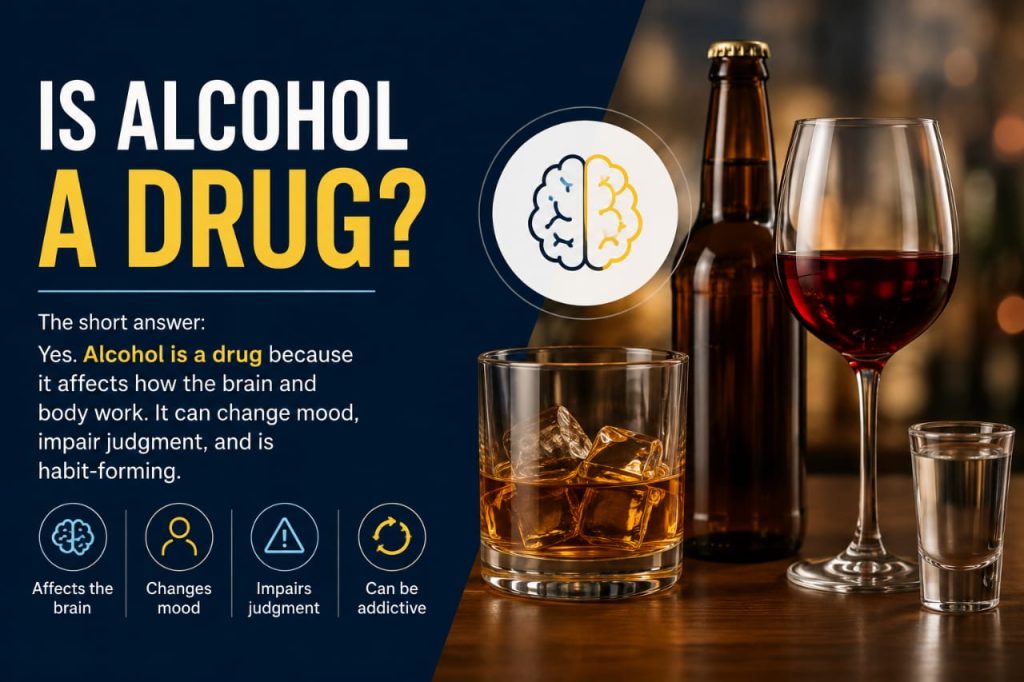
Alcohol is so common in restaurants, celebrations, parties, and social events that many people don’t think of it as a drug. Scientifically, however, alcohol is a drug.
Alcoholic beverages contain ethanol, a psychoactive and toxic substance that can cause dependence. The World Health Organization (WHO) classifies alcohol as a psychoactive, toxic, dependence-producing substance. (WHO: Alcohol)
So, why does alcohol seem different from substances people commonly call “drugs”?
The distinction has more to do with history, culture, regulation, and social acceptance than chemistry. In this guide, we’ll examine alcohol classification, how alcohol affects the brain and body, why it is considered a central nervous system depressant, and how legal drugs differ from illegal drugs.
What Makes Something a Drug?
In science and medicine, a drug is broadly understood as a substance that produces a physiological or psychological effect when introduced into the body.
More specifically, a psychoactive substance can influence mental processes such as mood, perception, cognition, consciousness, or behavior. Alcohol meets this definition because ethanol directly affects the brain and nervous system.
As a result, drinking alcohol can change mood, judgment, coordination, memory, speech, and behavior. The WHO likewise identifies alcohol as a psychoactive and toxic substance with dependence-producing properties. (WHO: Alcohol)
Is alcohol a psychoactive substance?
Yes. Alcohol is a psychoactive substance.
Once consumed, ethanol affects communication between nerve cells and changes normal brain activity. Consequently, a person’s mood, judgment, coordination, memory, and other neurological functions can be affected.
The National Institute on Alcohol Abuse and Alcoholism (NIAAA) explains that alcohol interferes with communication pathways in the brain and can affect areas responsible for balance, memory, speech, and judgment. (NIAAA: Alcohol and the Brain)
How Alcohol Affects the Brain and Body
Alcohol doesn’t only affect the liver. Instead, it can act throughout the body, influencing the brain, cardiovascular system, digestive system, immune system, pancreas, nervous system, and other organs. (NIAAA: Alcohol’s Effects on the Body),The specific effects depend on factors such as the amount consumed, drinking pattern, individual biology, and whether other substances or medications are involved.
Is alcohol a depressant?
Yes. Alcohol is generally classified as a central nervous system depressant.However, the term depressant can be confusing. It does not necessarily mean that alcohol makes someone feel depressed.
In pharmacology, a CNS depressant is a substance that generally slows or reduces nervous-system activity. Therefore, alcohol can impair normal neurological functions even when the person initially feels relaxed or more sociable.
Alcohol can produce effects such as:
- Relaxation
- Reduced inhibitions
- Drowsiness
- Slower reaction times
- Impaired coordination
- Difficulty concentrating
- Slurred speech
- Reduced judgment
- Memory impairment
- Loss of consciousness at very high levels
Some people initially feel more energetic or sociable after drinking. Nevertheless, this does not make alcohol a stimulant.
Reduced inhibitions can make someone feel more energetic while alcohol is simultaneously impairing neurological functions.
How does alcohol affect the brain?
Alcohol interferes with communication between brain cells. As intoxication increases, these changes can interfere with functions that require coordination, attention, and judgment.
According to NIAAA, alcohol can make it harder for brain regions responsible for balance, memory, speech, and judgment to function normally. (NIAAA: Alcohol and the Brain)
This helps explain why intoxication can affect decision-making, reaction time, coordination, and behavior.
Alcohol Classification: Drug, Depressant, or Both?
Alcohol can have several scientific classifications at the same time. These categories describe different characteristics of the same substance rather than competing definitions.
| Classification | Does alcohol fit? | Explanation |
|---|---|---|
| Drug | Yes | It produces measurable effects on the body and brain. |
| Psychoactive substance | Yes | It affects mood, cognition, perception, and behavior. |
| CNS depressant | Yes | It generally reduces nervous-system activity. |
| Toxic substance | Yes | Ethanol can damage tissues and contribute to disease. |
| Dependence-producing substance | Yes | Repeated use can lead to dependence in some people. |
| Legal substance | Often | Many countries permit regulated alcohol production and sale. |
Importantly, these classifications are not contradictory. A substance can simultaneously be legal, psychoactive, toxic, dependence-producing, and a drug.
Alcohol vs. Other Drugs: Why Does the Social Perception Differ?
If alcohol is a drug, why don’t people usually describe drinking a beer or glass of wine as “taking a drug”?
The answer is largely cultural and historical. Alcohol has been consumed in many societies for centuries and has become incorporated into social celebrations, restaurants, sporting events, religious traditions, and everyday life.
Furthermore, its legal status in many countries has helped distinguish alcohol socially from substances that are prohibited. WHO notes that alcohol has been widely used across cultures despite its psychoactive and dependence-producing properties. (WHO: Alcohol)
Legal drugs vs. illegal drugs
A common misconception is that legal means safe while illegal means dangerous.
However, scientific classification does not work that way. Legality is primarily determined by laws and regulations; it does not determine whether a substance affects the brain, produces physiological effects, causes dependence, or carries health risks.
Alcohol is a good example. Although it is legal and regulated in many jurisdictions, it remains a psychoactive substance associated with significant health risks.
Why is alcohol legal if it is a drug?
Governments have historically taken different approaches to regulating alcohol.
For example, many countries permit alcohol for adults while imposing restrictions involving:
- Minimum drinking ages
- Retail sales
- Licensing
- Advertising
- Taxation
- Public consumption
- Driving under the influence
The exact rules vary by jurisdiction. Therefore, legal status does not change alcohol’s pharmacological classification.
Short-Term Effects of Alcohol
The effects of alcohol can vary considerably. Factors such as the amount consumed, drinking speed, body composition, food intake, medications, health status, and individual tolerance can all influence how someone responds.
Short-term effects may include:
- Relaxation
- Reduced inhibitions
- Mood changes
- Impaired judgment
- Slower reaction time
- Poor coordination
- Slurred speech
- Drowsiness
- Nausea
- Memory impairment
At higher levels of intoxication, the situation can become medically dangerous. Severe alcohol intoxication can result in alcohol poisoning, unconsciousness, respiratory problems, seizures, coma, and death.
If someone cannot be awakened, has trouble breathing, has a seizure, or shows other signs of a medical emergency after drinking, seek emergency medical care immediately.
Long-Term Effects of Alcohol Consumption
The effects of alcohol aren’t limited to intoxication. Over time, repeated or heavy alcohol consumption can affect multiple organs and increase the risk of numerous health conditions.
WHO reports that alcohol consumption has a causal relationship with more than 200 diseases, injuries, and health conditions, including liver disease, cardiovascular conditions, cancers, mental-health conditions, and alcohol use disorders. (WHO: Alcohol)
Similarly, NIAAA reports that alcohol can affect multiple organs throughout the body. (NIAAA: Alcohol and the Human Body)
Long-term heavy or problematic alcohol use can contribute to:
- Liver disease
- Pancreatitis
- Cardiovascular problems
- High blood pressure
- Certain cancers
- Neurological problems
- Depression and anxiety
- Alcohol use disorder
- Injuries and accidents
Alcohol and cancer risk
Alcohol is also an established human carcinogen. Consequently, alcohol consumption is associated with an increased risk of several cancers.
These include cancers affecting the breast, liver, mouth, throat, esophagus, and colorectum. (WHO: Alcohol)
NIAAA likewise summarizes evidence linking alcohol consumption with several forms of cancer. (NIAAA: Alcohol’s Effects on the Body)
Can Alcohol Cause Dependence?
Yes, alcohol can lead to dependence.
Alcohol has dependence-producing properties, meaning repeated use can cause physical and psychological adaptations in some people. (WHO: Alcohol)
Alcohol use disorder (AUD) is a medical condition involving difficulty controlling alcohol use despite negative consequences.
Possible signs include:
- Drinking more or longer than intended
- Repeated unsuccessful attempts to cut down
- Strong cravings
- Continuing to drink despite health or relationship problems
- Spending substantial time obtaining or recovering from alcohol
- Developing tolerance
- Experiencing withdrawal symptoms
However, occasional alcohol consumption does not automatically mean someone has alcohol use disorder. Instead, AUD is diagnosed based on a broader pattern of symptoms and their impact on a person’s life.
Alcohol and Other Psychoactive Substances
Understanding alcohol as a drug is particularly important when considering interactions with other psychoactive substances.
Different substances can affect different neurological systems. As a result, combining psychoactive substances can create unpredictable or dangerous effects.
Alcohol can also interact with prescription medications and other drugs, particularly substances that depress the central nervous system. For this reason, anyone taking medication or using another psychoactive substance should speak with a healthcare professional or pharmacist before combining it with alcohol.
For readers interested in the broader subject of psychoactive substances, you can explore the educational resources in the Organic Shrooms Canada Blog.
Alcohol and Psychedelic Substances
Alcohol and psychedelic substances are pharmacologically different. Nevertheless, both can affect perception, behavior, and other aspects of nervous-system function.
Because combining psychoactive substances can make effects more difficult to predict, it is important not to assume that combining them is safe.
If you’re researching psychedelic substances, our educational resources include:
- What Is Psychedelic Integration?
- How Long Does It Take for Shrooms to Kick In?
- Can You Overdose on Shrooms?
- Organic Shrooms Canada FAQ
These pages provide additional educational context about psychedelic effects, timing, and safety.
Important: These internal resources are educational and should not be interpreted as medical advice or as evidence that combining alcohol with psychedelic substances is safe.
Why Understanding Alcohol as a Drug Matters
Calling alcohol a drug isn’t intended to sensationalize drinking. Rather, the classification helps explain why alcohol can affect judgment, coordination, brain function, physical health, and behavior.
It also challenges the misconception that a substance must be illegal to be pharmacologically active or capable of causing harm.
Ultimately, understanding the science can support more informed decisions and help reduce stigma surrounding alcohol-related problems.
Frequently Asked Questions
Is alcohol a drug?
Yes. Alcohol contains ethanol, a psychoactive substance that affects the brain and nervous system. WHO describes alcohol as a toxic, psychoactive, dependence-producing substance. (WHO: Alcohol)
Is alcohol a stimulant or depressant?
Alcohol is classified primarily as a central nervous system depressant. Although it can initially reduce inhibitions and make some people feel more energetic, its effects include impaired coordination, judgment, and reaction time.
Why is alcohol legal if it is a drug?
Alcohol is legal in many countries because governments have chosen to regulate its production, sale, and consumption rather than prohibit it completely.
However, legality does not determine whether something is a drug. A substance can be legal while still producing significant physiological and psychological effects.
Can alcohol cause addiction?
Yes. Alcohol can cause dependence and alcohol use disorder in some people.
Risk varies according to factors such as drinking patterns, genetics, environment, health, and other individual circumstances.
Is alcohol dangerous because it is a legal drug?
Legal status alone does not determine a substance’s health risk. In fact, WHO states that alcohol consumption is associated with more than 200 diseases, injuries, and other health conditions. (WHO: Alcohol)
Conclusion: So, Is Alcohol a Drug?
Yes—alcohol is a drug.
More specifically, ethanol is a psychoactive, toxic, dependence-producing substance that affects the brain and body.
Furthermore, alcohol is generally classified as a central nervous system depressant, even though its initial effects may sometimes feel stimulating because it can reduce inhibitions and alter mood.
Its legal and social acceptance in many countries does not change its pharmacological classification. In other words, legal status and drug classification are two different concepts.
Understanding alcohol classification, the effects of alcohol, and the distinction between legal drugs vs. illegal drugs can help people make better-informed decisions about substance use. It can also make it easier to recognize when professional support may be appropriate.rofessional.
