Magic Mushrooms
How to Microdose Mushrooms
Nov
A No-Nonsense Guide to Protocol, Dose, and Reality
Microdosing has become the wellness world’s worst-kept secret. Silicon Valley executives swear by it. Therapists whisper about it. Reddit threads spiral into endless debates about schedules and strains. But if you strip away the hype and the Instagram testimonials, what actually remains? A practice with genuine anecdotal support, mixed clinical evidence, and a whole lot of confusion about how to do it right.
At OrganicShroomsCanada, we believe that responsible exploration starts with honest information. This guide cuts through the noise. We will walk you through what a microdose actually is, how to find your dose, which schedules people use, and what the science—flawed as it sometimes is—tells us about what to expect.
What Counts as a Microdose?
The definition sounds simple: a sub-perceptual dose, small enough that you function normally without visual distortions or altered consciousness. In practice, the boundaries blur.
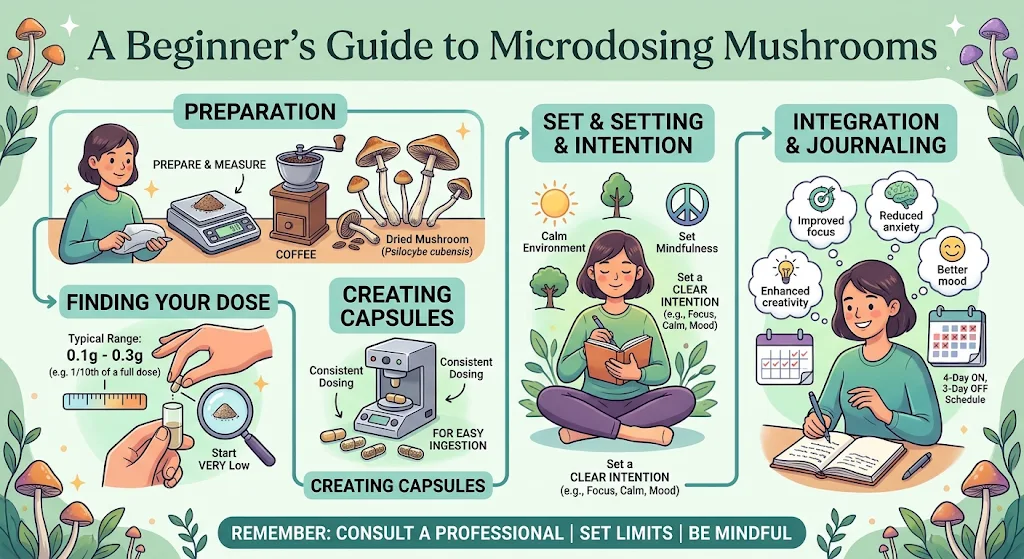
Researchers generally describe a microdose as roughly one-tenth to one-twentieth of a full psychedelic dose. Translated into dried mushroom weight, that lands somewhere between 0.1 and 0.5 grams . But here is where things get messy. Psilocybin content varies wildly between strains and even between individual mushrooms from the same batch. A 2026 naturalistic study tracking microdosers in the Netherlands found that participants who successfully completed a titration period settled on an average dose of 0.62 grams of dried mushrooms—noticeably higher than what many controlled trials administer .
That gap matters. It suggests that real-world microdosers often need more than laboratory protocols assume, and that rigid definitions may not serve anyone well.
Step One: Start Lower Than You Think
The golden rule of psychedelics applies doubly to microdosing: start low, go slower. If you have never consumed psilocybin before, beginning with 0.1 grams of dried mushroom is not overcautious. It is smart.
Your first dose is not about feeling anything dramatic. It is about establishing a baseline. Pay attention to subtle shifts—changes in mood, focus, or sensory perception. Some people notice nothing at this level. Others report a faint lift in mood or a slightly sharper edge to their attention. Both outcomes are normal.
If 0.1 grams produces no noticeable effects and no discomfort, increment slowly. The titration process is not a race. Give each dose level at least two or three dosing days before increasing. Your body and brain need time to reveal how they respond.
Step Two: Pick a Schedule (Then Break It If You Need To)
The microdosing community has produced two dominant schedules. The Fadiman protocol spaces doses every third day—one day on, two days off. The Stamets protocol stacks four or five consecutive dosing days followed by two or three days off, often paired with lion’s mane and niacin.
Here is the uncomfortable truth that protocol evangelists rarely mention: neither schedule has been validated by rigorous clinical trials. A 2024 qualitative study following microdosers over time found something more interesting. Participants typically began with rigid adherence to a protocol, then gradually abandoned strict schedules in favor of what felt right for their bodies and lives . One participant described treating microdosing “like I do the vitamins and supplements in the cupboard”—integrated into daily life rather than treated as a regimen .
That does not mean schedules are useless. They provide structure for beginners. But if a protocol leaves you feeling drained, foggy, or off, adjust it. The goal is not compliance. The goal is finding what works.
Step Three: Titrate to Your Sweet Spot
Titration is the process of adjusting your dose until you find the amount that produces the desired effects without unwanted side effects. A 2026 study found that two-thirds of participants who went through a structured titration period successfully identified an “optimal” dose . The benefits reported varied by dose level: low and medium doses reduced anxiety, while higher microdoses enhanced productivity and feelings of closeness to others .
Pay attention to what you actually want from microdosing. If you are seeking anxiety relief, a lower dose may serve you better. If you want creative energy or social ease, you might need slightly more. The dose that works for someone else on Reddit has no obligation to work for you.
What the Clinical Evidence Actually Shows
Now for the part that most guides gloss over. The science on microdosing is not nearly as settled as enthusiasts suggest.
A 2026 randomized clinical trial published in Europe PMC tested 2 mg psilocybin against placebo in participants with major depressive disorder. The results were sobering: both groups improved, but the psilocybin group did not outperform placebo . The researchers concluded that “trial participation itself contributed to clinically significant symptom improvement” .
Two double-blind placebo-controlled trials from Leiden University found no compelling evidence that microdosing enhanced cognitive performance or emotional well-being in healthy individuals . A mega-analysis pooling data from three trials on creativity reached similarly mixed conclusions .
Does this mean microdosing is useless? Not necessarily. The placebo effect is powerful, and if microdosing helps you feel better through expectation and ritual, that is not nothing. But it does mean you should approach grand claims about cognitive enhancement or depression cure with healthy skepticism. The evidence does not support certainty.
The Canadian Legal Reality
Psilocybin remains a controlled substance in Canada. Possession is illegal, regardless of dose size. Microdosing does not create a legal loophole .
Legal access exists through narrow channels. The Special Access Program allows physicians to request psilocybin for patients with serious conditions, and in June 2024, Health Canada granted its first SAP approval specifically for microdosing—to a patient treating cluster headaches . Clinical trials represent another pathway, and a November 2025 regulatory change now allows trial participants to take psilocybin home for self-administration, making microdosing research more feasible .
For everyone else, the legal status remains unchanged. We at OrganicShroomsCanada operate within existing frameworks and encourage customers to understand the legal landscape before making any decisions.
Safety Considerations That Actually Matter
Microdosing carries fewer acute risks than full-dose psychedelic experiences, but “fewer” is not “none.”
If you have a personal or family history of psychosis, bipolar disorder, or schizophrenia, psilocybin carries real risk of triggering episodes. If you take SSRIs or other serotonergic medications, interactions are possible, though research on this combination remains limited. And if you are sourcing mushrooms from unregulated channels, contamination and misidentification are genuine concerns—consuming the wrong mushroom can cause organ failure or death .
This is why product quality matters. When you browse our shop page, you will find strain information and potency details that allow you to make informed choices. We built OrganicShroomsCanada on the belief that transparency is not optional—it is the baseline.
Putting It All Together
Microdosing mushrooms is not complicated, but it does require patience and honesty with yourself. Start at 0.1 grams. Give each dose level time. Choose a schedule, but hold it loosely. Titrate toward effects you actually want, not effects someone else promised. And above all, respect the uncertainty in the science.
If you want to learn more about responsible use and explore quality products, visit our home page for educational resources and connect with our shop page when you are ready to browse. OrganicShroomsCanada exists to serve curious, cautious, informed customers—not reckless ones.
Microdosing is a tool, not a miracle. Use it accordingly.
