Uncategorized
Molly vs Ecstasy
Aug
Molly vs Ecstasy: What Is the Real Difference?
Medical Disclaimer: This article is for educational and public-health purposes only. It does not provide medical advice, diagnose conditions, or recommend the use of illegal or unregulated substances. If you or someone else is experiencing a medical emergency after taking an unknown substance, seek emergency medical care.
If you’ve searched for molly ecstasy, you may have noticed that the terms Molly, Ecstasy, and MDMA are often used interchangeably. There is an important distinction, however: MDMA is the chemical compound, while Molly and Ecstasy are informal names used for products marketed as containing MDMA.
The biggest misconception is that Molly automatically means “pure MDMA” while Ecstasy automatically means an impure pill. In reality, the name, appearance, or form of an illicit product cannot reliably establish what chemicals it contains. NIDA reports that substances sold as Molly may contain other drugs or may contain no MDMA at all.
For more educational information about psychedelic substances, visit the Organic Shrooms Canada Blog.
What Is MDMA?
MDMA stands for 3,4-methylenedioxymethamphetamine. It is a synthetic psychoactive substance with stimulant and mind-altering effects.
The National Institute on Drug Abuse (NIDA) describes MDMA as a synthetic drug commonly known as Ecstasy or Molly.
The important public-health distinction is that MDMA is a specific chemical compound, whereas Molly and Ecstasy are street terms that may be used for products of uncertain composition.
Ecstasy vs. Molly: Core Differentiating Factors
Form and appearance
Traditionally, the terms have been associated with different physical forms:
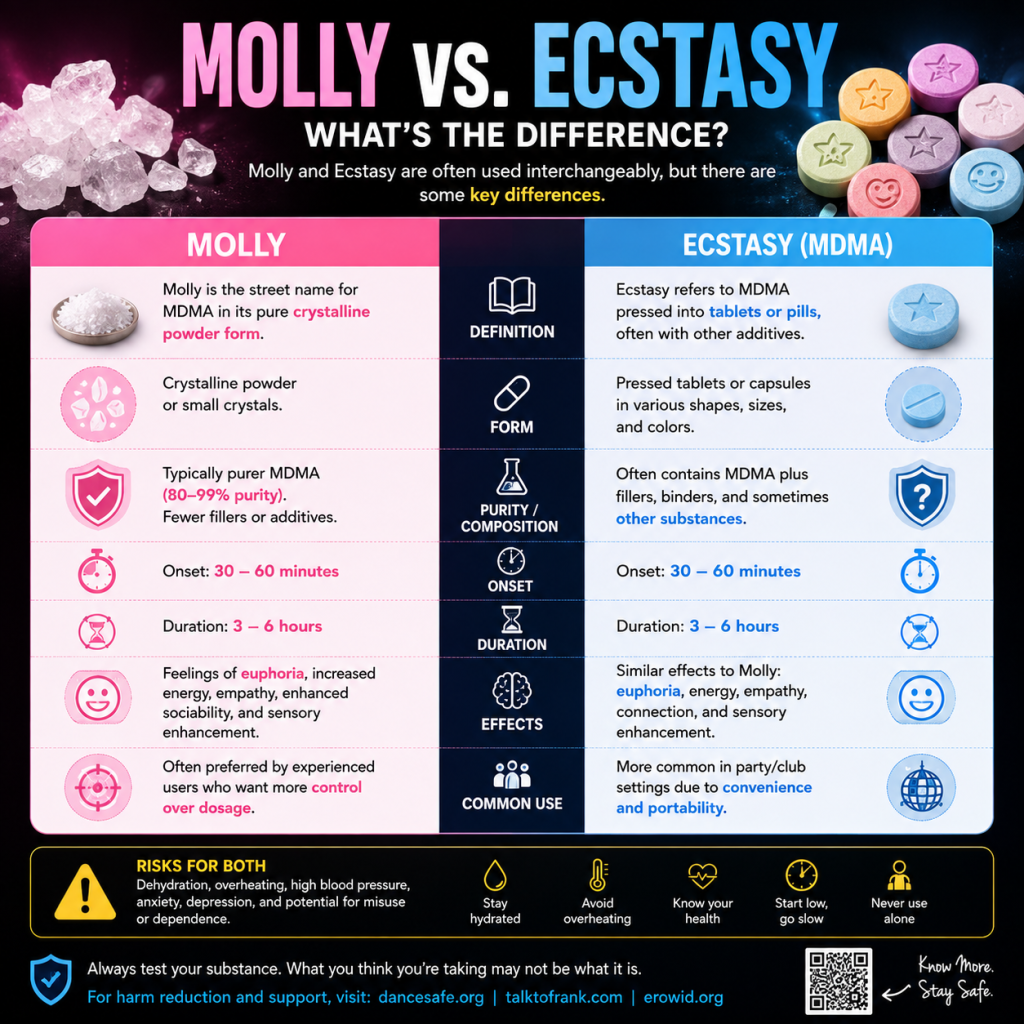
| Feature | Ecstasy | Molly |
|---|---|---|
| Commonly marketed form | Pressed tablets or pills | Powder, crystals, or capsules |
| Appearance | Often colored or stamped with logos | Often white or off-white powder/crystals |
| Street perception | Often associated with MDMA-containing tablets | Often marketed as “pure” MDMA |
| What appearance tells you | Cannot reliably establish contents | Cannot reliably establish contents |
| Actual composition | May contain MDMA, other drugs, or mixtures | May contain MDMA, other drugs, or mixtures |
The distinction is therefore primarily about form and street terminology, rather than a guaranteed chemical difference.
Street perception vs. reality
A common misconception is that Molly is inherently purer than Ecstasy.
It isn’t safe to make that assumption.
NIDA reports that chemical analyses of drugs sold as Molly have found other substances and, in some cases, no MDMA.
CDC guidance similarly notes that illicit stimulants are unregulated, making their dosage and purity difficult to determine.
Therefore, the difference between Molly and Ecstasy is less important from a safety perspective than knowing that either product may have an uncertain composition.
Is Molly Pure MDMA?
No. Molly is not automatically pure MDMA.
“Molly” is commonly used to describe MDMA in powder or crystalline form, but the name itself does not provide laboratory confirmation of the contents.
NIDA specifically cautions that substances sold as Molly may contain other drugs or may not contain MDMA.
That makes the question “is Molly pure MDMA?” particularly important for public-health education.
The safest conclusion is that appearance and street terminology cannot establish purity.
Ecstasy Pills vs. Powder: Does Form Matter?
The distinction between ecstasy pills vs. powder is often presented as a difference in purity, but physical form alone cannot establish chemical composition.
Ecstasy pills
Pressed tablets may contain MDMA, but they can also contain other substances.
A tablet’s logo, color, shape, or branding does not provide reliable evidence about its chemical contents.
CDC notes that MDMA sold as Molly or Ecstasy can be mixed with other substances, including other stimulants and synthetic cathinones.
Powder or crystals marketed as Molly
Powder or crystalline material may be marketed as MDMA or Molly, but that label does not guarantee that it contains MDMA or that it contains only MDMA.
Bottom line: A pill is not automatically more dangerous because it is a pill, and powder is not automatically safer because it looks crystalline.
The Purity Problem and Hidden Adulterants
One of the central issues in substance use harm reduction is uncertainty about what an unregulated drug actually contains.
NIDA has documented adulterants and substituted substances associated with products sold as MDMA or Molly, including substances such as caffeine, methamphetamine, dextromethorphan, ephedrine, cocaine, and synthetic cathinones.
CDC also states that illicit stimulants are unregulated, meaning dosage and purity can be difficult to determine.
Why adulteration matters
Unknown ingredients can produce effects that differ from what someone expects.
They can also complicate medical treatment because healthcare professionals may not initially know which substance or combination of substances was taken.
This is why statements such as “Molly is pure” or “this Ecstasy pill is safe because it has a familiar logo” can create a dangerous false sense of certainty.
Shared Risks and Physiological Effects
Whether a product is sold as Molly or Ecstasy, the health effects depend on what it actually contains.
When MDMA is present, it affects several neurotransmitter systems, including serotonin, dopamine, and norepinephrine. It can produce stimulant and mood-altering effects while also affecting cardiovascular and temperature regulation.
Potential effects and complications can include:
- Increased heart rate
- Increased blood pressure
- Increased body temperature
- Sweating
- Muscle tension or jaw clenching
- Nausea
- Anxiety or agitation
- Confusion
- Changes in perception or mood
Serious MDMA-related illness can include hyperthermia, seizures, metabolic disturbances, rhabdomyolysis, organ failure, and other life-threatening complications.
When should someone seek emergency help?
Emergency medical attention is warranted for symptoms such as:
- Very high body temperature
- Severe confusion or agitation
- Loss of consciousness
- Seizures
- Difficulty breathing
- Severe chest pain
- Collapse or inability to wake
Do not assume that a person will simply “sleep it off” if they are unconscious, severely confused, having a seizure, or experiencing serious physical symptoms.
When seeking medical care, tell healthcare professionals what was reportedly taken if that information is available.
Harm Reduction and Safety Resources
Substance use harm reduction focuses on reducing preventable injury, illness, and death.
For substances sold as Molly or Ecstasy, several general safety principles are particularly important.
Don’t assume a street name tells you what’s inside
“Molly,” “Ecstasy,” and other names describe how a substance may be marketed. They do not constitute laboratory confirmation of its chemical composition.
Be aware of polysubstance risks
Combining psychoactive substances can increase risk and make effects less predictable.
CDC explains that polysubstance use can involve combinations of stimulants and depressants and can increase overdose risk.
For additional information about psychedelic experiences, see What Is Psychedelic Integration?.
Know the warning signs of toxicity
Severe overheating, seizures, unconsciousness, breathing problems, severe confusion, and collapse require urgent medical attention.
Consider professional support
If substance use is becoming difficult to control, affecting relationships or work, or causing repeated health problems, speaking with a doctor, addiction specialist, counselor, or other qualified healthcare professional can be an important step.
People do not need to wait until a substance-use problem becomes severe before seeking support.
Related Reading
You can explore additional educational resources from Organic Shrooms Canada:
- How Long Does It Take for Shrooms to Kick In?
- Can You Overdose on Shrooms?
- What Is Psychedelic Integration?
- Organic Shrooms Canada Blog
- Frequently Asked Questions
Frequently Asked Questions
Are Molly and Ecstasy the same thing chemically?
Not necessarily. MDMA is a specific chemical compound, while Molly and Ecstasy are informal terms used for products marketed as containing MDMA. A product sold under either name may contain MDMA, other substances, or a mixture.
Is Molly safer than Ecstasy?
There is no reliable basis for assuming that Molly is safer than Ecstasy. The physical form or street name does not establish purity or chemical composition. NIDA specifically warns that products sold as Molly can contain other substances or no MDMA.
Is Molly pure MDMA?
No—not necessarily. Although Molly is commonly marketed as powdered or crystalline MDMA, the name does not guarantee that the substance contains MDMA or that it contains only MDMA.
How can someone test for purity?
No visual inspection, logo, color, or street name can establish that a product is pure MDMA.
Where legally available, drug-checking and laboratory analysis can provide information about a substance’s chemical contents, but testing cannot make an unregulated substance risk-free.
People should consult legitimate local public-health or harm-reduction organizations for current information about testing services in their jurisdiction.
Molly vs. Ecstasy: The Bottom Line
The terms Molly ecstasy can be confusing because they are frequently used interchangeably, but they describe street-market terminology rather than two reliably standardized products.
MDMA is the chemical compound. Ecstasy is commonly associated with pressed tablets, while Molly is often marketed as powder, crystals, or capsules. However, neither appearance nor name guarantees purity or confirms what is actually in an illicit product.
The most important public-health lesson is therefore to avoid equating “Molly” with pure MDMA or assuming that one physical form is inherently safer than another.
Understanding the uncertainty around illicit drug contents, recognizing signs of toxicity, avoiding assumptions about purity, and knowing when to seek professional help are central principles of evidence-based substance use harm reduction.
Medical Disclaimer
This article is intended for general educational purposes and is not a substitute for professional medical advice, diagnosis, or treatment. Information about illicit substances can change as drug markets and adulterants change. If you believe you or someone else is experiencing poisoning or a medical emergency, seek emergency medical care immediately.
Sources & Further Reading
CDC: MDMA-Related Health Risks — documented serious health complications associated with MDMA exposure.ency medical care immediately.
National Institute on Drug Abuse (NIDA): MDMA (Ecstasy/Molly) — background on MDMA, effects, and terminology.
NIDA: MDMA/Ecstasy Research Report — information on adulterants and risks associated with illicit MDMA products.
CDC: Stimulant Guide — information about illicit stimulant purity, MDMA, and contamination.
CDC: Polysubstance Use — public-health information about risks associated with mixing substances.
