DMT
WHAT IS DMT? @2026 Facts
Aug
The Complete Guide to WHAT IS DMT?, Effects, Risks, and Legal Status in Canada
Dimethyltryptamine, commonly known as DMT, occupies a fascinating place in the study of human consciousness. Sometimes called the “Spirit Molecule,” DMT belongs to a family of psychedelic compounds known for producing profound changes in perception, emotion, and awareness.
For anyone researching this compound, however, the subject involves much more than psychedelic experiences. DMT also raises important questions about pharmacology, neuroscience, traditional practices, mental health, safety, and Canadian law.
This comprehensive guide explains what DMT is, how it affects perception and the brain, how it differs from ayahuasca, what risks researchers have identified, and what Canadian law says about the substance.
For a broader introduction to natural psychedelics, explore our Ultimate Guide to Psilocybin Shrooms.
Why Understanding DMT Matters Today
Interest in psychedelic science has grown considerably in recent years. Researchers now study compounds such as DMT, psilocybin, LSD, and MDMA in controlled scientific settings.
Organizations such as the Multidisciplinary Association for Psychedelic Studies (MAPS) have helped advance psychedelic research and public education. Meanwhile, academic institutions continue to investigate how psychedelic substances influence perception, cognition, emotional processing, and consciousness.
DMT attracts particular attention because of its remarkably rapid and intense effects. Within a short period, a person can experience dramatic changes in visual perception, their sense of time, their body awareness, and their sense of self.
Nevertheless, scientific interest does not mean that researchers have answered every question about DMT. Many claims surrounding the compound remain speculative, particularly claims about supernatural experiences or alternate dimensions.
Therefore, anyone researching DMT should separate established scientific evidence from personal reports, cultural interpretations, and commercial claims.
For more educational information about psychedelics, visit the Organic Shrooms Canada Blog.
What Is DMT?
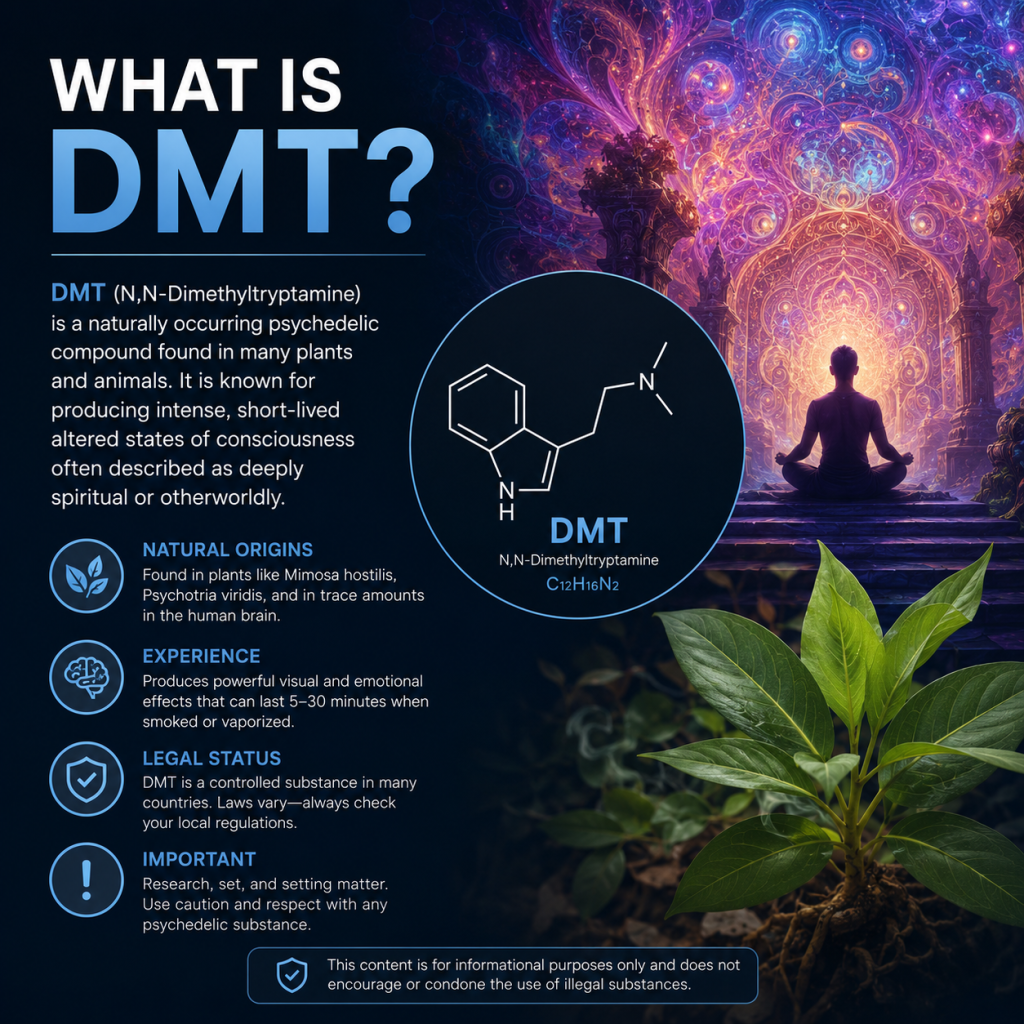
N,N-Dimethyltryptamine (DMT) is a naturally occurring psychedelic compound that belongs to the tryptamine family.
Chemically, DMT shares structural similarities with serotonin, an important neurotransmitter involved in several processes, including mood, cognition, sleep, and perception.
The PubChem Compound Database provides additional information about DMT’s chemical structure and classification.
Natural Sources of DMT
Researchers have identified DMT in numerous plant species. One well-known example is Psychotria viridis, a plant traditionally used as a source of DMT in some ayahuasca preparations.
Scientists have also investigated the presence and metabolism of DMT in animals. However, the biological significance of naturally occurring DMT in the human body remains an area of ongoing research.
In addition to natural sources, laboratories can synthesize DMT. Purified DMT may appear as a crystalline solid, although appearance alone cannot establish a substance’s identity or purity.
How People Encounter DMT
DMT can enter the body through different routes, and each route produces a different pharmacological profile.
In traditional ayahuasca preparations, DMT-containing plants combine with plants containing monoamine oxidase inhibitors, commonly called MAOIs. These compounds inhibit enzymes that would otherwise break down orally consumed DMT before it can produce its characteristic psychedelic effects.
Traditional ayahuasca practices have received considerable attention from researchers studying ethnobotany, religion, pharmacology, and psychedelic experiences. Educational resources from the Heffter Research Institute provide additional background on psychedelic science.
Inhaled DMT, on the other hand, produces a much faster onset and a comparatively brief psychedelic experience.
What Does a DMT Experience Feel Like?
DMT has a reputation for producing extremely intense alterations in consciousness. The experience can differ dramatically from one person to another, so no single description applies to everyone.
Several factors can influence the experience, including psychological state, expectations, environment, individual biology, and route of administration.
People have reported experiences involving:
- Extremely vivid visual imagery
- Geometric patterns
- Changes in colors and shapes
- Altered perception of time
- Distorted body awareness
- Changes in the sense of self
- Intense emotional responses
- Feelings of awe or interconnectedness
- Confusion or disorientation
- Anxiety or fear
- Experiences interpreted as encounters with apparently autonomous entities
Importantly, these experiences can feel completely real while they occur. A person’s subjective perception, however, does not automatically establish that an alternate dimension or external entity objectively exists.
The Rapid Onset
When people inhale DMT, effects can begin very quickly. The transition from ordinary consciousness to an altered state may occur within a short period.
Consequently, the experience can feel sudden and overwhelming. Changes in visual perception, hearing, body awareness, and the perception of the surrounding environment may occur almost simultaneously.
The Peak Experience
During an intense psychedelic experience, some individuals report what they describe as a “breakthrough.”
At this point, ordinary awareness of the surrounding environment may become greatly reduced. Some people report elaborate environments, geometric imagery, profound emotional experiences, or encounters with apparently autonomous beings.
Others experience a temporary loss of their ordinary sense of identity, which researchers and psychedelic users commonly call ego dissolution.
Although these experiences can feel extraordinary, scientists continue to debate how the brain generates such complex subjective states.
Returning to Ordinary Awareness
The intense effects of inhaled DMT generally decline much faster than those associated with many other classic psychedelics.
Even so, the end of the peak does not necessarily mean that every psychological effect disappears immediately. A person may continue to feel emotionally affected, reflective, confused, or unusually sensitive for some time afterward.
For people interested in the broader world of psychedelic mushrooms, our Dried Magic Mushrooms Collection provides additional educational information.
How DMT Affects the Brain
DMT interacts with several systems in the brain. Researchers have paid particular attention to its activity at serotonin receptors, especially the 5-HT2A receptor.
These receptors play an important role in the effects of several classic psychedelics.
However, DMT’s effects involve more than a single receptor. Scientists continue to investigate how changes in brain signaling produce the distinctive alterations in perception, cognition, emotion, and self-awareness associated with DMT.
Changes in Visual Perception
DMT can dramatically alter visual processing.
People may report:
- Bright or unusual colors
- Repeating geometric structures
- Rapidly changing imagery
- Distortions of familiar objects
- Complex three-dimensional scenes
- Changes in depth and spatial awareness
Some people also describe synesthesia-like effects, in which different sensory experiences seem to overlap.
Emotional Effects
Emotional responses can vary just as widely as visual experiences.
For example, some people report:
- Awe
- Wonder
- Euphoria
- Peace
- Connectedness
- Curiosity
Others may experience:
- Fear
- Panic
- Confusion
- Anxiety
- Existential distress
As a result, nobody can guarantee that a psychedelic experience will feel positive, meaningful, or enjoyable.
Ego Dissolution
One of the most frequently discussed psychological effects involves ego dissolution.
The term describes a temporary weakening or disappearance of the ordinary sense of being a separate and continuous self.
For some people, this experience feels profound or liberating. For others, it can feel confusing or frightening because their usual framework for understanding themselves temporarily changes.
Researchers continue to study the relationship between ego dissolution, brain-network activity, emotional processing, and long-term psychological outcomes.
Physical Effects of DMT
Alongside psychological changes, DMT can produce noticeable physical effects.
Reported effects can include:
- Increased heart rate
- Increased blood pressure
- Dilated pupils
- Dizziness
- Changes in muscle coordination
- Tremors
- Nausea with some preparations
- Changes in body temperature or bodily awareness
The combination of intense psychological effects and impaired coordination can create practical safety concerns.
For instance, someone experiencing profound alterations in consciousness may not recognize hazards in their immediate environment. Therefore, physical surroundings deserve careful consideration whenever psychedelic experiences are discussed.
DMT Safety and Harm Reduction
DMT deserves serious consideration from a safety perspective because its effects can develop rapidly and become extremely intense.
One widely discussed concept in psychedelic harm reduction is set and setting.
Set
“Set” refers to a person’s psychological state, expectations, mood, and emotional condition before an experience.
Setting
“Setting” refers to the physical and social environment surrounding the experience.
A calm and familiar environment may reduce some situational risks, while an unpredictable or dangerous environment can increase them.
However, set and setting cannot eliminate all medical or psychological risks.
Why Supervision Matters
DMT can significantly impair awareness, judgment, coordination, and the ability to respond to the surrounding environment.
Consequently, a person experiencing intense psychedelic effects may not recognize physical hazards or respond appropriately during an emergency.
A sober and trusted individual may help reduce environmental risks. Nevertheless, supervision does not guarantee safety or prevent medical complications.
Mental Health Considerations
People with certain psychiatric conditions may face greater risks from psychedelic experiences.
In particular, anyone with a personal history of psychosis or certain severe psychiatric disorders should seek professional medical advice before considering psychedelic substances.
Family psychiatric history may also matter. A qualified healthcare professional can help someone understand how their individual circumstances could affect risk.
DMT and Medication Interactions
Medication interactions deserve special attention, particularly when MAOIs enter the picture.
Ayahuasca preparations can contain MAOIs that affect the metabolism of various drugs and neurotransmitters. Consequently, combining MAOI-containing preparations with certain medications or substances can create serious health risks.
People who take antidepressants, stimulants, psychiatric medications, or other prescription drugs should speak with a doctor or pharmacist before considering substances that may interact with their medication.
It is also important to avoid simplistic claims that every combination of DMT with an antidepressant will automatically cause serotonin syndrome. The actual risk depends on the specific substances, mechanisms, doses, and individual circumstances.
For additional educational information about psychedelic safety, explore our Psychedelic Harm Reduction Guide.
Independent harm-reduction resources such as Erowid and DanceSafe also provide information about psychoactive substances and risk reduction.
DMT vs. Ayahuasca
Although DMT plays a central role in ayahuasca, the two terms do not describe the same thing.
DMT
DMT refers to the psychedelic compound itself.
When administered through a route that allows rapid absorption, DMT can produce a very intense psychedelic state that develops quickly and generally subsides much faster than a traditional ayahuasca experience.
Ayahuasca
Ayahuasca refers to a traditional psychoactive preparation associated particularly with Indigenous and other cultural traditions in South America.
Traditional preparations generally combine plants containing DMT with plants containing MAOIs.
The MAOI component changes DMT metabolism. As a result, orally consumed DMT can produce psychedelic effects that last considerably longer than those associated with rapidly administered DMT.
Therefore, describing ayahuasca simply as “DMT in tea” oversimplifies its chemistry, cultural history, pharmacology, and potential risks.
Is DMT Addictive?
DMT does not appear to produce the same pattern of physical dependence associated with substances such as opioids or alcohol.
Nevertheless, that distinction does not make the substance completely risk-free.
Psychological difficulties can still develop when someone relies on psychoactive substances to escape emotional problems or repeatedly pursues intense experiences despite negative consequences.
Furthermore, the short duration of DMT’s main effects does not mean that the substance has no psychological or physical risks.
DMT and the Question of Other Dimensions
One of the most fascinating aspects of DMT experiences involves reports of entering apparently separate worlds or encountering autonomous entities.
These reports have become a major part of popular discussions about the substance.
However, scientists must distinguish between what a person experiences and what that experience proves about external reality.
A person can genuinely experience an apparently independent world or entity without that experience providing scientific evidence that the world or entity exists outside the brain.
Researchers continue to investigate why psychedelic states can produce such detailed and convincing experiences.
As a result, DMT remains an interesting subject not only for neuroscience but also for philosophy, psychology, and consciousness research.
The Legal Status of DMT in Canada
Anyone researching DMT in Canada should understand the federal legal framework.
Canada’s Controlled Drugs and Substances Act
DMT appears in Schedule III of Canada’s Controlled Drugs and Substances Act.
Federal law restricts unauthorized activities involving controlled substances, including possession, production, trafficking, importation, and related activities.
You can consult the Department of Justice Canada Laws Website for the current federal legislation.
For general background, you can also review the Legal Status of Psychedelic Drugs in Canada.
Local Enforcement Does Not Equal Legalization
Occasionally, local developments involving psychedelic substances receive significant media attention.
However, local enforcement priorities do not automatically change federal drug laws.
Therefore, people should not assume that the existence of psychedelic-related services, events, or businesses in a particular Canadian location means that DMT has become legal throughout the country.
Research and Authorized Activities
Certain researchers, healthcare professionals, and organizations may work with controlled substances under applicable licences, exemptions, or regulatory frameworks.
Those arrangements differ from general public legalization.
Because Canadian regulations can change, anyone seeking current legal information should consult official federal sources or a qualified Canadian legal professional.
Common Mistakes When Researching DMT
The large amount of information available online can make it difficult to separate reliable evidence from speculation.
Underestimating the Intensity
DMT can produce an exceptionally powerful psychedelic experience.
Treating it like a mild recreational substance can therefore lead to unrealistic expectations and poor preparation.
Ignoring Set and Setting
A stressful or physically unsafe environment can increase the possibility of panic, confusion, or accidents.
For that reason, researchers and harm-reduction organizations frequently discuss environmental factors when studying psychedelic experiences.
Assuming Natural Means Safe
DMT occurs naturally in some plants, but that fact does not make it harmless.
Many naturally occurring compounds can produce powerful pharmacological effects. Safety depends on factors such as pharmacology, dose, interactions, individual health, and circumstances.
Trusting Unverified Online Claims
Commercial websites, social-media posts, and online forums may make unsupported claims about purity, medical benefits, legality, or safety.
Whenever possible, compare those claims with peer-reviewed research, government information, and advice from qualified healthcare professionals.
Neglecting Integration
A psychedelic experience can leave a person with strong emotions or questions.
Some people find it helpful to reflect on those experiences through journaling, conversation, mindfulness, or professional counseling.
Integration does not require accepting every interpretation of an experience. Instead, it can provide an opportunity to examine what happened and determine whether any practical insight can be applied to everyday life.
Frequently Asked Questions (FAQs)
What is the difference between smoked DMT and Ayahuasca?
Vaporized DMT acts rapidly and produces a short, intense experience. Ayahuasca contains DMT plus MAOIs, creating a slower-onset experience that generally lasts much longer.
What is “Ego Dissolution” and why does it happen on DMT?
Ego dissolution describes a temporary loss or weakening of the usual sense of self. During intense DMT experiences, perception and self-awareness can change dramatically.
Can you microdose DMT like psilocybin?
DMT microdosing is discussed online, but scientific evidence remains limited. Its rapid, intense effects differ significantly from the gradual and sustained effects often associated with psilocybin microdosing.
What are the legal risks and realities of DMT in Canada?
DMT is listed as a Schedule III substance under Canada’s Controlled Drugs and Substances Act. Unauthorized possession, production, or distribution can carry serious legal consequences.
What is psychedelic integration and how do you process a DMT trip?
Psychedelic integration involves reflecting on an experience and processing its emotional or personal meaning. Journaling, discussion, and professional support can help turn experiences into useful insights.
Responsible Research and Professional Guidance
Anyone researching DMT should approach the subject with curiosity as well as skepticism.
Scientific evidence can help distinguish established facts from personal interpretations. Government resources can clarify legal questions. Meanwhile, qualified healthcare professionals can provide individualized guidance about medical conditions and medication interactions.
For educational information about other psychedelic compounds, you can explore the Organic Shrooms Canada website.
If you are researching psychedelics for academic or scientific purposes, prioritize peer-reviewed research and established institutions over anonymous online claims.
Conclusion: Understanding DMT Responsibly
DMT remains one of the most intriguing compounds in modern psychedelic science. Its rapid onset and profound effects have made it an important subject in research into perception, consciousness, neurochemistry, and the human sense of self.
At the same time, extraordinary experiences do not automatically provide proof of supernatural realities or alternate physical dimensions. A subjective experience can feel completely real while scientists continue to debate its underlying meaning and mechanism.
Ultimately, responsible education requires a balanced approach. Researchers and readers should consider the available evidence, acknowledge uncertainty, understand potential risks, and remain aware of the legal environment.
In Canada, DMT remains a federally controlled substance under the Controlled Drugs and Substances Act. Anyone seeking current information should consult official Canadian government resources and qualified professionals rather than relying solely on commercial websites or outdated online discussions.
For more educational resources about psychedelics and related topics, visit the Organic Shrooms Canada Blog.
Educational Disclaimer: This article is provided for informational and educational purposes only. It does not constitute medical or legal advice and does not encourage the illegal possession, production, purchase, sale, or use of controlled substances.
