magic mushroms facts
Different Types of Shrooms 15 Fascinating Strains, Potency & Species Guide
Aug
Different Types of Shrooms: 15 Fascinating Strains, Potency & Species Guide
Introduction
When you explore the world of fungi, you quickly discover that mushrooms are incredibly diverse. From edible culinary varieties to functional mushrooms and naturally occurring psychedelic species, there are thousands of mushroom species with different appearances, habitats, chemical compositions, and traditional uses.
The phrase different types of shrooms is often used broadly, particularly when people are searching for information about psychedelic mushrooms. However, mushrooms that contain psilocybin represent only one part of the much larger fungal kingdom.
Understanding the differences between species, cultivated varieties, and non-psychoactive functional mushrooms can help readers navigate mushroom-related information more responsibly. Some mushrooms are primarily valued for food and nutrition, while others are studied for their naturally occurring compounds and potential wellness applications.
There are more than 100 known species of mushrooms that contain psilocybin or related compounds, although the exact number of recognized species continues to develop as mycologists conduct additional research and classification work.
If you have been researching different types of shrooms, this guide explains the major categories, commonly discussed species, cultivated varieties, differences in potency, and the important distinction between psychedelic and functional mushrooms.
For readers interested in mushroom products and wellness-focused options, you can explore Organic Shrooms Canada.
Understanding Different Types of Shrooms: Species vs. Strains
Before comparing individual mushrooms, it is important to understand the difference between a species and a strain.
These terms are sometimes used interchangeably online, but they do not mean exactly the same thing.
What Is a Mushroom Species?
A species is a biological classification used to distinguish organisms based on characteristics such as genetics, reproduction, and evolutionary relationships.
Examples of psychedelic mushroom species include Psilocybe cubensis, Psilocybe semilanceata, and Psilocybe azurescens.
These species can naturally occur in different environments and geographic regions.
For a broader biological overview, readers can explore Wikipedia’s Psilocybin Mushroom Entry.
What Is a Cultivated Strain?
A cultivated strain generally refers to a selected or cultivated lineage within a species.
For example, many commonly discussed cultivated varieties belong to Psilocybe cubensis. Names such as Golden Teacher, B+, and Penis Envy are often used to distinguish particular cultivated lineages or varieties.
This distinction matters because two mushrooms may have different names while belonging to the same underlying species.
In other words, when comparing different types of shrooms, it is useful to determine whether you are comparing genuinely different species or varieties within the same species.
For information about Canadian regulations and controlled substances, consult Health Canada.
1. Psilocybe Cubensis
Psilocybe cubensis is one of the best-known psychedelic mushroom species.
It occurs naturally in tropical and subtropical environments and has also become widely recognized because of its historical presence in mushroom research and discussions surrounding psilocybin.
The species is associated with mushrooms that can contain psilocybin and psilocin, two naturally occurring psychoactive compounds.
Because P. cubensis has been studied and discussed extensively, it is frequently used as a reference point when people compare different types of shrooms.
However, individual mushrooms can vary considerably in their chemical composition. Therefore, appearance alone cannot reliably establish potency.
2. Psilocybe Semilanceata
Psilocybe semilanceata, commonly known as the Liberty Cap, is another well-known psilocybin-containing species.
It is particularly associated with grassland environments in parts of Europe and other temperate regions.
The species is recognized by its small stature and distinctive cap shape. Despite its relatively small size, it has attracted considerable scientific and cultural interest because of its naturally occurring psychoactive compounds.
Its characteristics make it an important example when learning about naturally occurring different types of shrooms.
3. Psilocybe Azurescens
Psilocybe azurescens is a species associated with coastal areas of the Pacific Northwest.
It is known for its distinctive appearance and naturally occurring psilocybin and psilocin content.
The species is frequently mentioned in discussions about mushroom potency. However, claims that one species is always stronger than another should be treated carefully because alkaloid concentrations can vary between individual mushrooms, growing conditions, genetics, and other factors.
Consequently, it is not scientifically reliable to determine potency simply by looking at a mushroom or relying on its popular name.
4. Psilocybe Cyanescens
Psilocybe cyanescens is another naturally occurring psilocybin-containing species.
It is commonly associated with wood-rich environments and has been documented in several regions.
The species is often included in lists discussing different types of shrooms because of its distinctive appearance and chemical profile.
As with other wild mushrooms, identification requires considerable expertise. Many mushroom species can look similar, and misidentification can have serious consequences.
5. Psilocybe Tampanensis
Psilocybe tampanensis is a less commonly encountered species associated with the southeastern United States.
It has attracted interest because of its classification within the Psilocybe genus and its association with psilocybin.
Although it is less widely recognized than P. cubensis, it demonstrates how broad the category of psilocybin-containing fungi can be.
6. Psilocybe Mexicana
Psilocybe mexicana is another species with a long history of ethnobotanical interest.
The species has been documented in Mexico and has played an important role in historical discussions about traditional relationships between humans and psychoactive fungi.
Its cultural significance makes it an important part of understanding the history behind different types of shrooms.
7. Psilocybe Subaeruginosa
Psilocybe subaeruginosa is associated primarily with Australia and nearby regions.
It is another naturally occurring species containing psilocybin and psilocin.
Like other wild species, its characteristics can vary depending on environmental conditions and genetics. Identification should therefore be left to qualified experts rather than based solely on photographs or online descriptions.
Popular Cultivated Varieties of Psilocybe Cubensis
One of the most confusing aspects of different types of shrooms is the large number of names used for cultivated Psilocybe cubensis varieties.
These names may refer to differences in physical appearance, lineage, genetics, or reported characteristics.
Importantly, a variety name should not automatically be treated as a scientific species designation.
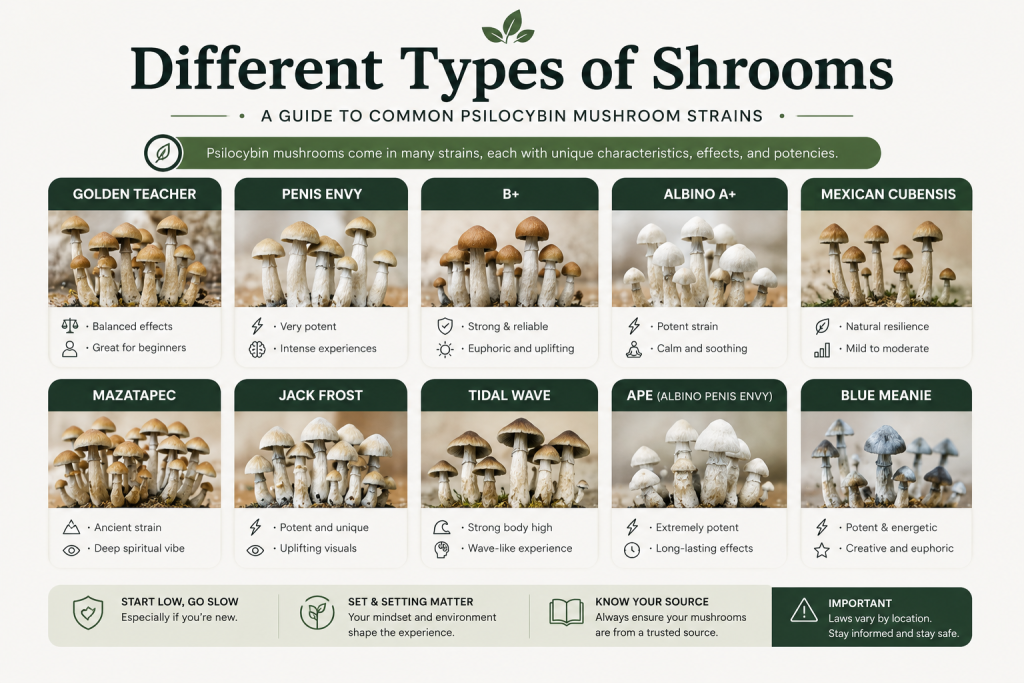
Golden Teacher
Golden Teacher is one of the most widely recognized cultivated Psilocybe cubensis varieties.
It is generally associated with golden or yellowish caps and has become particularly prominent in online mushroom communities.
Because the name is widely recognized, it frequently appears in searches for different types of shrooms.
Penis Envy
Penis Envy is another well-known cultivated variety.
It is recognized for its unusual physical characteristics and is frequently discussed in relation to potency.
However, reported potency can vary between samples. A variety name alone should not be treated as a laboratory measurement.
B+ Strain
B+ is another commonly referenced Psilocybe cubensis variety.
It has become widely recognized within mushroom culture and is frequently mentioned in discussions about cultivated varieties.
As with other named varieties, individual samples may differ, so appearance and variety names should not be treated as precise indicators of chemical composition.
How Potency Can Differ Between Mushrooms
Potency is one of the most frequently discussed topics when comparing different types of shrooms.
Psilocybin and psilocin concentrations can vary substantially among species and individual mushrooms. Genetics, environmental conditions, maturity, storage, and other factors can influence chemical composition.
This means that two mushrooms that look almost identical may not necessarily contain identical concentrations of active compounds.
Likewise, a mushroom with a larger cap or thicker stem is not automatically more potent than a smaller specimen.
Why Appearance Does Not Reliably Show Potency
Many online descriptions attempt to associate particular colours, shapes, bruising patterns, or physical features with strength.
However, visual characteristics are not a reliable substitute for laboratory analysis.
This is particularly important with wild mushrooms because appearance can vary naturally and some unrelated species can resemble one another.
For that reason, readers should be cautious about websites or social-media posts making absolute claims about potency based solely on appearance.
Wild Mushrooms vs. Cultivated Mushrooms
Another important distinction when studying different types of shrooms is whether a mushroom is wild or cultivated.
Wild Species
Wild mushrooms grow naturally in their respective environments.
Their characteristics can be influenced by:
- Climate
- Soil
- Moisture
- Genetics
- Geographic location
- Available nutrients
- Seasonal conditions
Wild mushroom identification can be challenging, particularly for inexperienced observers.
Cultivated Varieties
Cultivated mushrooms are grown under managed conditions.
Many popular mushroom varieties discussed online originate from cultivation and selective propagation.
Cultivation can produce more consistent physical characteristics, but that does not necessarily mean every individual mushroom has exactly the same chemical composition.
Functional Mushrooms Are Different
Not all mushrooms referred to as “shrooms” are psychedelic.
Functional mushrooms are an entirely different category and are commonly associated with nutrition, wellness, and ongoing scientific research.
Examples include:
Lion’s Mane
Lion’s Mane is widely recognized for its distinctive appearance and has attracted research interest related to cognition, nerve health, and neurological function.
It does not belong to the same category as psilocybin-containing psychedelic mushrooms.
Reishi
Reishi has a long history of traditional use and is commonly included in modern wellness products.
Research has explored its naturally occurring compounds and potential biological activities.
Cordyceps
Cordyceps is another widely recognized functional mushroom.
It is particularly popular among people interested in exercise, energy, endurance, and general wellness.
Chaga
Chaga is a fungus traditionally associated with birch trees and is often discussed because of its antioxidant compounds and broader nutritional properties.
These functional varieties demonstrate why the phrase different types of shrooms should not automatically be interpreted as meaning psychedelic mushrooms.
Psychedelic Mushrooms vs. Functional Mushrooms
The distinction between these two categories is essential.
Psychedelic mushrooms are generally discussed because they may contain psychoactive compounds such as psilocybin.
Functional mushrooms, on the other hand, are commonly used as food ingredients, powders, extracts, teas, and supplements.
They are not interchangeable.
For example, Lion’s Mane does not produce the same psychoactive effects associated with psilocybin-containing mushrooms. Similarly, Reishi and Cordyceps are generally discussed within the functional mushroom and wellness categories.
Understanding this distinction can help readers make better-informed decisions when researching mushroom products.
Why Mushroom Identification Matters
Correct identification is particularly important when dealing with wild mushrooms.
Some poisonous mushroom species can resemble edible or psychoactive species. Misidentification can lead to serious poisoning.
For this reason, readers should never rely exclusively on an online article, photograph, social-media post, or automated identification tool when determining whether a wild mushroom is safe.
Professional identification is especially important when a mushroom may be consumed.
Are All Different Types of Shrooms Equally Potent?
No.
Different species and individual mushrooms can contain different concentrations of naturally occurring compounds.
Even within a single species or cultivated variety, potency can vary.
This is why broad statements such as “this mushroom is always twice as strong” should be viewed critically unless supported by reliable laboratory data.
Popular names can be useful for classification and discussion, but they are not a substitute for chemical analysis.
Can You Tell a Mushroom’s Strength by Looking at It?
Generally, no.
Physical appearance can provide clues about identification, but it cannot reliably establish the concentration of active compounds.
Cap colour, stem thickness, size, bruising, and other characteristics may vary naturally.
Therefore, when comparing different types of shrooms, readers should distinguish between observable physical traits and scientifically measured chemical composition.
Why Are There So Many Mushroom Names?
Mushroom naming can become confusing because several systems overlap.
A mushroom may have:
- A scientific species name
- A common name
- A regional name
- A cultivated variety name
- A historical name
- An informal community nickname
For example, a popular cultivated name may refer to a variety within a species rather than representing a completely separate species.
This explains why mushroom lists online can sometimes appear much larger than the actual number of scientifically recognized species.
Frequently Asked Questions About Different Types of Shrooms
1. What are the different types of shrooms?
The term can refer to many categories, including psychedelic species such as Psilocybe cubensis, Psilocybe semilanceata, and Psilocybe azurescens, as well as cultivated varieties and non-psychoactive functional mushrooms.
2. What is the most common type of psychedelic mushroom?
Psilocybe cubensis is among the most widely recognized and studied psilocybin-containing mushroom species.
3. Are mushroom strains and species the same thing?
No. A species is a biological classification, while a strain or cultivated variety generally refers to a particular lineage or selected variation within a species.
4. Are some types of shrooms more potent than others?
Yes, concentrations of psilocybin and related compounds can vary between species and individual mushrooms. However, potency can also vary considerably within the same species.
5. Is Penis Envy a separate species?
The name Penis Envy is generally used for a cultivated Psilocybe cubensis variety rather than a completely separate mushroom species.
6. Is Golden Teacher a different species?
Golden Teacher is generally discussed as a cultivated Psilocybe cubensis variety rather than a separate species.
7. Can you identify mushroom potency by appearance?
No. Appearance alone cannot reliably determine the concentration of active compounds.
8. Are Lion’s Mane and Reishi psychedelic mushrooms?
No. Lion’s Mane and Reishi are generally categorized as functional mushrooms rather than psilocybin-containing psychedelic mushrooms.
9. Why do different mushroom varieties have different names?
Names can describe species, cultivated lineages, physical characteristics, geographic origins, or historical and community terminology.
10. Are wild mushrooms safe to identify yourself?
Wild mushroom identification can be difficult and potentially dangerous. Some poisonous species resemble other mushrooms, so professional identification is recommended before consumption.
11. Where can I learn more about mushroom wellness?
Readers interested in functional mushrooms and general mushroom wellness can explore educational resources and products from Organic Shrooms Canada.
Final Thoughts on Different Types of Shrooms
The world of mushrooms is far more diverse than the phrase different types of shrooms might initially suggest.
Psychedelic mushroom species such as Psilocybe cubensis, Psilocybe semilanceata, and Psilocybe azurescens belong to a category associated with naturally occurring psilocybin and psilocin. Within some species, cultivated varieties have developed their own names and reputations.
At the same time, functional mushrooms such as Lion’s Mane, Reishi, Cordyceps, and Chaga belong to a different category. These mushrooms are generally explored for nutrition, wellness, and scientific research rather than psychedelic effects.
Potency is another area where caution is important. Species, individual mushrooms, genetics, environmental conditions, and other factors can influence chemical composition. Consequently, appearance or a popular variety name cannot reliably tell you how potent a mushroom is.
Understanding the difference between species, cultivated varieties, psychedelic mushrooms, and functional mushrooms provides a much clearer picture of the fungal world.
If you want to continue learning about mushrooms, explore the educational resources available through Organic Shrooms Canada, and always rely on reputable scientific and health information when researching psychoactive or wild mushroom species.
