
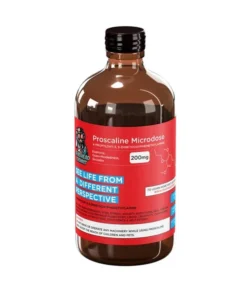
Proscaline Microdose (Mescaline Analogue)
$170.00
Secure high-purity Proscaline Microdose (Mescaline Analogue) for precision laboratory analysis and academic investigations. As a distinguished substituted phenethylamine, this compound offers consistent structural integrity and reliability for specialized research applications. Each batch is synthesized to meet strict scientific standards, making it an essential addition to any analytical reference library.
Proscaline Microdose (Mescaline Analogue): Complete Analytical Reference & Technical Guide
The Proscaline Microdose (Mescaline Analogue) serves as a vital reference standard for academic institutions, forensic laboratories, and neuropharmacological researchers studying phenethylamine derivatives and 5-HT receptor interactions. Because contemporary scientific inquiry requires exceptional purity and compound stability, this material is synthesized under rigorous laboratory controls. Furthermore, researchers frequently examine this analogue to map structural relationships within the broader class of psychedelic compounds. Consequently, laboratories worldwide rely on this specific substance for accurate analytical benchmarking.
Phenethylamines remain a foundational pillar in mapping structure-activity relationships (SAR) within psychedelic and psychoactive chemistry. As a 4-alkoxy analogue of mescaline, Proscaline—specifically 2-(3,5-dimethoxy-4-propoxyphenyl)ethan-1-amine—offers unique binding profile dynamics for comparative pharmacological research.
   CH3-CH2-CH2-O
         |
    [ Benzene ]—O-CH3
         |
       O-CH3
         |
    CH2-CH2-NH2
Every batch of our Proscaline Microdose (Mescaline Analogue) undergoes comprehensive testing, including NMR spectroscopy and high-performance liquid chromatography (HPLC) purity analysis, to ensure maximum compound stability and inter-assay reproducibility across diverse quantitative protocols.
Chemical Properties and Specifications
When acquiring reference materials, consistency remains paramount. This compound exhibits distinct structural characteristics that differentiate it from traditional phenethylamines:
-
IUPAC Name: 2-(3,5-dimethoxy-4-propoxyphenyl)ethan-1-amine
-
Systematic Name: 4-propoxy-3,5-dimethoxyphenethylamine
-
Molecular Formula: C₁₃H₂₁NO₃
-
Molecular Weight: 239.31 g/mol
-
CAS Number: 39201-78-0
-
Purity Standard: High-grade analytical synthesis (≥ 98.0% HPLC/GC-MS verified)
-
Physical Form: Fine off-white crystalline solid
-
Solubility: Soluble in distilled water ($H_2O$), Ethanol, DMSO, and Methanol
-
Storage Environment: -20°C to 4°C (Desiccated environment)
As a result, investigators receive a stable product designed to yield reproducible data across multiple testing frameworks.
The Role of Proscaline in Modern Research
Historically, compounds related to mescaline have provided deep insights into neuropharmacology. Researchers utilize this analogue to observe receptor binding affinities without standardizing variables found in crude plant extracts. Therefore, utilizing a precise Proscaline Microdose (Mescaline Analogue) format allows for granular observation during in vitro or analytical assays. In addition, its lipophilic properties make it a unique subject for comparative pharmacokinetic studies.
+--------------------------------------------------------------------------+
|                      Core Experimental Uses                              |
+--------------------------------------------------------------------------+
|  1. 5-HT2A & 5-HT2C Serotonin Receptor Affinity Profiling                |
|  2. Comparative Mass Spectrometry & Forensic Calibration                 |
|  3. Structure-Activity Relationship (SAR) Mapping vs. Mescaline/Escaline |
|  4. In Vitro Metabolic Stability & Lipophilicity Assays                  |
+--------------------------------------------------------------------------+
1. Serotonin Receptor Binding Assays
Researchers frequently select the Proscaline Microdose (Mescaline Analogue) to investigate selective activation across 5-HT₂ family receptors. By replacing the 4-methoxy group of mescaline with a longer 4-propoxy chain, Proscaline alters steric bulk at the binding pocket. Studies utilizing radioligand binding assays track how this hydrophobic elongation impacts binding affinity ($K_i$) and functional intrinsic activity ($EC_{50}$) at the 5-HT₂₠ and 5-HT₂C subtypes.
Published pharmacological evaluations in major scientific literature (Kolaczynska et al., 2022) demonstrate that extending the 4-alkoxy chain significantly increases binding affinities compared to the baseline mescaline molecule.
2. Structure-Activity Relationship (SAR) Dynamics
Mapping functional groups along the benzene ring of phenethylamines helps illuminate receptor domain topography. The Proscaline Microdose (Mescaline Analogue) acts as a crucial bridge within the homologated scaline series:
-
Mescaline: 4-methoxy substitution
-
Escaline: 4-ethoxy substitution
-
Proscaline: 4-propoxy substitution
-
Buscaline: 4-butoxy substitution
Observing step-wise homologation down the 4-alkoxy series reveals critical data regarding steric tolerances inside G-protein coupled receptors (GPCRs). Comparative neuropharmacological research available via the National Center for Biotechnology Information (NCBI) highlights how subtle chain modifications dramatically alter ligand-receptor kinetics.
3. HPLC and Mass Spectrometry Benchmarking
Forensic and academic toxicology laboratories require pristine reference standards to calibrate instrumentation. Utilizing a Proscaline Microdose (Mescaline Analogue) sample yields distinct retention times on reverse-phase HPLC columns and unambiguous fragmentation patterns during LC-MS/MS tandem mass spectrometry, eliminating false-positive overlaps during multi-analyte screenings.
Handling and Analytical Protocol Guidelines
Proper handling procedures ensure safety, integrity, and accuracy in professional laboratory settings:
-
Equip Proper PPE: Always wear nitrile gloves, protective eyewear, and a lab coat when handling active chemical powders to prevent accidental skin contact or inhalation.
-
Weigh with Precision: Utilize a calibrated analytical balance capable of measuring micro-quantities (milligrams) to ensure exact sizing for your specific experimental parameters.
-
Prepare Solutions Correctly: If liquid chromatography or stock solutions are required, dissolve the measured compound in an appropriate laboratory solvent (such as distilled water or ethanol) in a sealed volumetric flask.
-
Storage Management: Store the container in a cool, dark, and dry environment (ideally between 0°C to -20°C) to maintain long-term chemical stability.
Step-by-Step Volumetric Preparation Protocol
[ Step 1: Micro-Mass Weighing ] ──► [ Step 2: Solubilization ] ──► [ Step 3: Aliquoting & Freezing ]
  Calibrate balance to ±0.1 mg       Dissolve in LC-MS solvent         Flush container with N2 gas
  Measure in anti-draft hood         Sonicate for 3-5 minutes          Store stock solution at -20°C
-
Micro-Mass Determination: Utilize a calibrated analytical balance capable of measuring down to micro-quantities ($\pm 0.1\text{ mg}$) inside an anti-draft enclosure.
-
Solvent Selection: Prepare stock solutions using LC-MS grade methanol or deionized distilled water ($H_2O$) for analytical runs, or laboratory-grade DMSO for cellular assays.
-
Volumetric Dissolution: Transfer the accurately weighed Proscaline Microdose (Mescaline Analogue) into a volumetric flask. Add the desired solvent incrementally while maintaining a controlled ambient temperature ($20\text{^\circ C} – 22\text{^\circ C}$).
-
Homogenization: Gentle sonication for 3 to 5 minutes ensures complete dissolution without thermal degradation of the phenethylamine backbone.
Advanced Pharmacokinetics and Chemical Stability
Understanding the physical behavior of phenethylamine derivatives is essential when designing multi-variable assays. The extended 4-propoxy chain of Proscaline increases its lipophilicity (XLogP3 = 1.7) relative to mescaline, directly influencing its passive membrane permeability and volume of distribution in vitro.
       [ Hydrophobic 4-Propoxy Chain ]
                     │
                     ▼
    ┌─────────────────────────────────┐
    │  Enhanced Membrane Permeability │
    └─────────────────────────────────┘
                     │
                     ▼
  ┌─────────────────────────────────────┐
  │  Elevated 5-HT2 Receptor Affinity   │
  └─────────────────────────────────────┘
Storage Best Practices for Extended Integrity
-
Temperature Control: Store dry powder reference samples at $-20\text{^\circ C}$ for long-term storage (up to 36 months). Reconstituted liquid stock solutions should be kept at $-80\text{^\circ C}$.
-
Desiccated Environment: Keep vials sealed inside desiccator chambers filled with active silica gel to prevent hygroscopic water absorption.
-
Photolytic Protection: Store compounds in amber glass vials or light-impermeable secondary packaging to block ultraviolet degradation.
-
Inert Atmosphere: Flush storage containers with nitrogen or argon gas prior to sealing to eliminate oxidative pathways.
Academic labs seeking further comparative data on psychoactive derivatives can review extensive chemical datasets indexed on PubChem Chemical Database.
Comparative Analysis: Scaline Analogue Series
To assist researchers in selecting appropriate analytical targets, the following comparison highlights key physical and binding distinctions across the primary 4-alkoxy phenethylamine analogues:
-
Mescaline (4-Methoxy):
-
Molecular Weight: 211.26 g/mol
-
Steric Bulk: Baseline 4-position substitution
-
Receptor Affinity: Baseline 5-HT₂A/₂C activation
-
-
Escaline (4-Ethoxy):
-
Molecular Weight: 225.28 g/mol
-
Steric Bulk: Moderate extension (+14 Da shift)
-
Receptor Affinity: Intermediate binding affinity increase
-
-
Proscaline (4-Propoxy):
-
Molecular Weight: 239.31 g/mol
-
Steric Bulk: Hydrophobic propoxy extension (+28 Da shift)
-
Receptor Affinity: Up to 63-fold increase in 5-HT₂A affinity over mescaline
-
-
Buscaline (4-Butoxy):
-
Molecular Weight: 253.34 g/mol
-
Steric Bulk: Maximum chain extension (+42 Da shift)
-
Receptor Affinity: Decreased efficacy due to steric hindrance in the binding pocket
-
Utilizing a Proscaline Microdose (Mescaline Analogue) sample provides the ideal middle ground for probing maximum steric tolerance within the GPCR binding domain.
Quality Control & Analytical Verification
Every batch of our reference standard undergoes rigorous analytical testing prior to distribution. Laboratories receive full documentation to support compliance and audit requirements:
+--------------------------------------------------------------------------+
|                  Batch Quality Assurance Standards                       |
+--------------------------------------------------------------------------+
|  • Nuclear Magnetic Resonance (1H-NMR & 13C-NMR) Verification            |
|  • High-Performance Liquid Chromatography (HPLC) Purity > 98.0%           |
|  • Mass Spectrometry (GC-MS / LC-MS) Molecular Weight Confirmation       |
|  • Certificate of Analysis (CoA) Provided with Every Order               |
+--------------------------------------------------------------------------+
Our synthesis protocols ensure that each Proscaline Microdose (Mescaline Analogue) batch is completely free of unreacted precursor intermediates, heavy metals, or residual synthesis solvents.
If your research facility also explores natural fungal derivatives, explore our complete selection of microdosing formulations directly at Organic Shrooms Canada.
Conclusion and Ordering Information
Ultimately, the Proscaline Microdose (Mescaline Analogue) provides unmatched reliability for academic and institutional studies. Every shipment is carefully packaged to protect material composition during transit. Place your order today to secure premium-grade reference materials for your facility.
Be the first to review “Proscaline Microdose (Mescaline Analogue)”
Related products
Microdosing
Microdosing

Microdosing
Reviews
There are no reviews yet.