
Uncategorized
How Long Does Ativan Last?
Aug
How Long Does Ativan Last? Effects, Half-Life & How Long It Stays in Your System
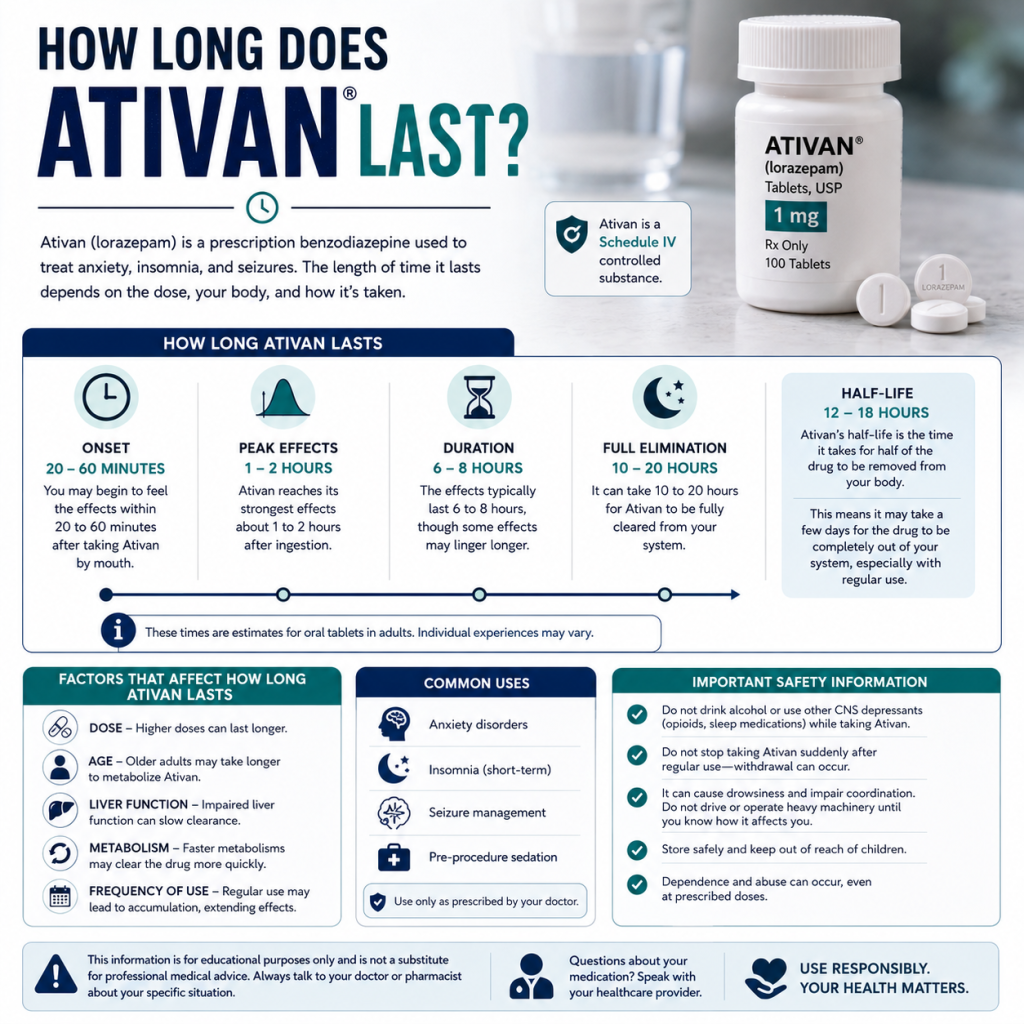
If you’re wondering how long does Ativan last, it’s important to distinguish between how long you can feel its effects and how long the medication remains in your body. Ativan, the brand name for lorazepam, is a benzodiazepine prescribed for conditions including anxiety. Its noticeable effects can last for several hours, while the drug remains in the body considerably longer.
Quick answer: Oral lorazepam generally reaches peak blood concentrations at about 2 hours after a dose. Its elimination half-life averages approximately 12 hours, so the medication can remain in the body well after its noticeable effects have worn off. Individual response and duration can vary.
Medical note: Ativan is a prescription medication. If you are taking lorazepam, follow your prescriber’s instructions and speak with a healthcare professional about questions involving dosage, interactions, side effects, or stopping treatment.
Active Effects: How Long Does Ativan Work?
Ativan contains lorazepam, a benzodiazepine that slows activity in the central nervous system.
After an oral dose, lorazepam is absorbed relatively quickly. Peak blood concentrations generally occur at approximately 2 hours.
The experience can vary significantly from one person to another. Some people may notice calming or sedating effects for several hours, while others may experience drowsiness or impaired alertness for longer.
How long does Ativan take to work?
Oral Ativan generally begins producing noticeable effects relatively soon after taking a dose, with blood concentrations reaching their peak at approximately 2 hours.
The timing can vary depending on the individual, dose, other medications, food intake, and other factors.
For comparison, the onset and duration of psychoactive substances can be very different. If you’re researching mushroom effects, you can read our guide on how long it takes for shrooms to kick in.
How long does Ativan make you sleepy?
Drowsiness is a known effect of lorazepam and may last beyond the period when you feel the medication’s primary anxiety-relieving effects.
If Ativan makes you sleepy or affects your coordination or concentration, don’t drive, operate machinery, or perform potentially dangerous activities until you are fully alert.
There is no reliable “one-size-fits-all” number of hours for how long sedation will last.
Understanding the Ativan Half-Life
The Ativan half-life is approximately 12 hours on average.
A drug’s half-life refers to the approximate time required for the amount of medication in the body to decrease by 50%.
Using a simplified example:
- After about 12 hours: approximately 50% remains
- After about 24 hours: approximately 25% remains
- After about 36 hours: approximately 12.5% remains
- After about 48 hours: approximately 6.25% remains
- After about 60 hours: approximately 3.1% remains
These numbers are a pharmacokinetic illustration rather than a prediction of an individual’s exact drug concentration.
Importantly, half-life is not the same thing as duration of effects. A medication may continue to be present in the body even after its noticeable effects have decreased.
How Long Does Ativan Stay in Your System?
If you’re asking how long does Ativan stay in your system, there isn’t one exact answer.
Lorazepam can remain in the body for considerably longer than its noticeable effects. Detection also depends on the type of test, the test’s sensitivity, the amount taken, how frequently it was used, and individual characteristics.
Ativan detection times by test
| Test | What to know |
|---|---|
| Blood | Generally provides a shorter detection window than tests designed to identify longer-term exposure. |
| Urine | Lorazepam or related compounds may remain detectable for days, but the exact window varies considerably. |
| Saliva | May detect recent exposure, with the window generally shorter than hair testing. |
| Hair | Can provide a much longer historical window of drug exposure, but has important limitations. |
There is no guaranteed detection period that applies to everyone. A laboratory’s testing method and cutoff can affect whether a sample is reported as positive or negative.
A detection result should also not be interpreted as proof that someone is currently experiencing the effects of lorazepam.
What Affects How Long Ativan Lasts?
Several factors can influence lorazepam duration, including the following.
Dose
Higher doses can produce stronger pharmacological effects and may affect how long someone experiences sedation or other effects.
Never increase your dose simply because you feel that the medication has “worn off.” Take lorazepam only as prescribed.
Age
Older adults may be more sensitive to benzodiazepines and may experience greater or prolonged sedation.
Metabolism
People process medications at different rates. Individual differences can therefore affect how quickly lorazepam is eliminated.
Liver and kidney function
The body’s ability to process and eliminate medications can be affected by liver or kidney problems. Your healthcare professional can determine whether adjustments or additional monitoring are appropriate.
Frequency of use
Repeated dosing means that a new dose can be taken while some medication from an earlier dose remains in the body.
This can affect overall exposure and may contribute to accumulation with repeated use.
Other medications and substances
Other substances can increase lorazepam’s sedating effects.
In particular, combining benzodiazepines with opioids or alcohol can increase the risk of severe sedation and respiratory depression. Always tell your healthcare professional about prescription medications, over-the-counter medicines, supplements, and recreational substances you use.
This is particularly important for anyone researching psychoactive substances. Our educational article Can You Overdose on Shrooms? discusses safety concerns surrounding psychedelic mushroom use.
Ativan Side Effects Duration
The Ativan side effects duration varies from person to person.
Possible side effects include:
- Drowsiness
- Dizziness
- Weakness
- Poor coordination
- Reduced alertness
- Difficulty concentrating
- Fatigue
Side effects may continue after the medication’s primary therapeutic effects become less noticeable.
If side effects are severe, persistent, or interfere with normal activities, contact your healthcare professional.
Ativan and psychoactive substances
People researching Ativan may also be researching other psychoactive substances. However, you should not assume that combining lorazepam with psychedelic mushrooms or other substances is safe.
Different substances can have unpredictable effects when taken together. If you are currently taking Ativan and are considering another psychoactive substance, discuss the combination with a qualified healthcare professional first.
For readers interested in the broader topic of psychedelic experiences, see our educational guide to psychedelic integration.
When is Ativan an emergency?
Get emergency medical attention if someone taking lorazepam develops severe difficulty breathing, extreme sedation, inability to wake, or loss of consciousness, especially if alcohol, opioids, or other central nervous system depressants were also used.
Can You Stop Ativan Suddenly?
If you’ve been taking Ativan regularly, don’t stop it suddenly without medical guidance.
Benzodiazepines can cause physical dependence. Abrupt discontinuation or rapid dose reduction can result in withdrawal reactions, which can sometimes be serious.
The safest discontinuation strategy depends on the individual. A healthcare professional can create a gradual taper appropriate for the person’s medication history and clinical circumstances.
Frequently Asked Questions
How long does Ativan last?
Ativan’s noticeable effects can last for several hours, but the exact duration varies by person and dose. Lorazepam has an average elimination half-life of approximately 12 hours, meaning it remains in the body substantially longer than its noticeable effects.
How long does Ativan take to work?
Oral lorazepam is absorbed relatively quickly and generally reaches peak blood concentrations at approximately 2 hours after administration.
How long does Ativan stay in your system?
Lorazepam can remain in the body for considerably longer than its noticeable effects. The exact duration depends on factors such as dose, repeated use, individual metabolism, and the type and sensitivity of the drug test.
Can you stop taking Ativan suddenly?
If you’ve been taking Ativan regularly, you should not stop suddenly without speaking with your healthcare professional. Rapid discontinuation can cause potentially serious benzodiazepine withdrawal reactions.
Related Reading
If you’re researching psychoactive substances, effects, and safety, these related resources from Organic Shrooms Canada may also be useful:
- How Long Does It Take for Shrooms to Kick In?
- Can You Overdose on Shrooms?
- What Is Psychedelic Integration?
- Organic Shrooms Canada Blog
- Frequently Asked Questions
These pages are already part of the site’s existing content structure.
Key Takeaway
The answer to “how long does Ativan last?” depends on what you mean by “last.”
The medication’s noticeable effects may wear off before the drug has been eliminated from the body. Lorazepam reaches peak blood concentrations at approximately 2 hours and has an average elimination half-life of around 12 hours.
If you’re concerned about lingering drowsiness, drug testing, interactions, side effects, or stopping Ativan, talk with your doctor or pharmacist rather than changing your dose on your own.
Medical Disclaimer: This article is for educational and informational purposes only and does not constitute medical advice, diagnosis, or treatment. Ativan (lorazepam) is a prescription benzodiazepine. Individual responses, effects, side effects, elimination, and drug-test detection can vary. Take the medication only as prescribed, avoid combining it with alcohol or other sedating substances unless your healthcare professional has specifically advised you, and do not stop regular benzodiazepine treatment abruptly without medical guidance.
