magic mushroms facts
Types of Magic Mushrooms
Aug
Types of Magic Mushrooms
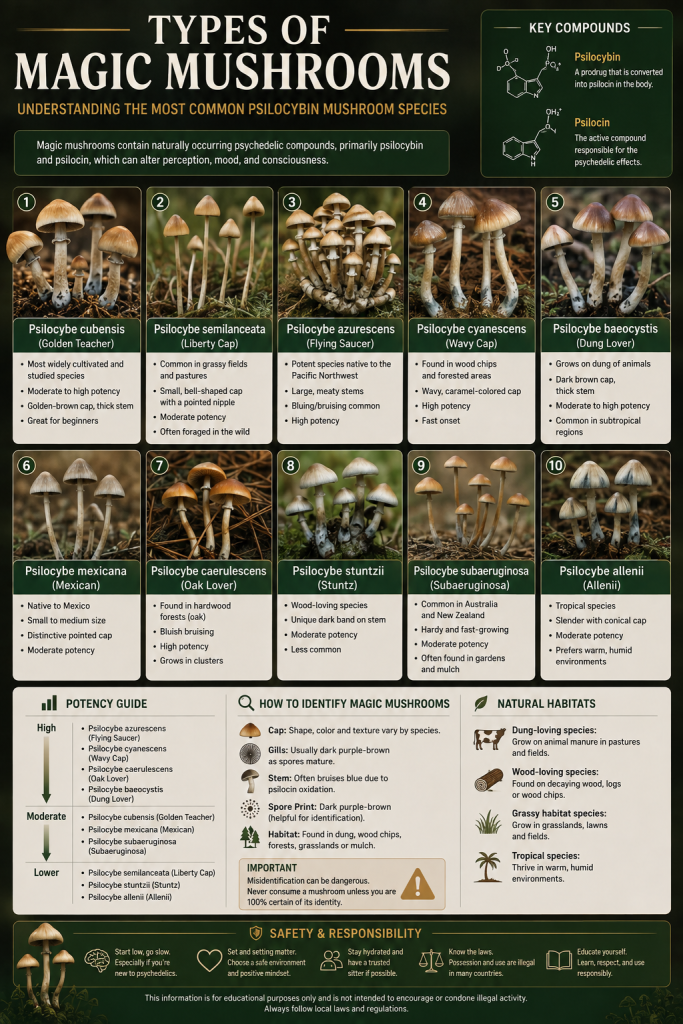
Magic mushrooms include more than 200 known species of fungi that naturally contain the psychoactive compounds psilocybin and psilocin. Although these mushrooms share similar chemical properties, each species differs in appearance, habitat, geographic distribution, growth conditions, and naturally occurring concentrations of psilocybin.
Some species are widely recognized because they have been studied extensively or are commonly referenced in educational resources, while others are less common and occur only in specific regions of the world. Understanding the different types of magic mushrooms helps readers appreciate the diversity of the genus and the ongoing scientific interest surrounding these unique fungi.
In this guide, we’ll explore the most well-known psilocybin mushroom species, explain their distinguishing characteristics, discuss where they naturally grow, and highlight why they continue to attract scientific attention.
What Are Magic Mushroom Species?
Magic mushrooms belong to several genera of fungi, although the majority of known psilocybin-producing mushrooms belong to the Psilocybe genus. Scientists have identified more than 200 species that naturally produce psilocybin, but only a relatively small number are widely recognized in scientific literature and educational publications.
Each species has unique characteristics, including:
- Cap shape and color
- Stem size and texture
- Habitat and climate
- Geographic distribution
- Growth season
- Naturally occurring psilocybin content
Although many species share similarities, accurate identification requires specialized knowledge because numerous poisonous mushrooms resemble psilocybin-containing species.
For a broader introduction, read our What Are Magic Mushrooms? guide.
The Most Common Types of Magic Mushrooms
1. Psilocybe cubensis
Psilocybe cubensis is one of the most recognized and extensively documented psilocybin mushroom species worldwide. It naturally grows in warm, humid climates and has become the species most frequently discussed in scientific research and educational resources.
Characteristics include:
- Golden to caramel-colored cap
- Thick white stem
- Bluing reaction when handled
- Widely distributed in tropical and subtropical regions
Many popular varieties belong to this species, making it an ideal starting point for learning about psilocybin mushrooms.
Continue Reading:
- Psilocybe cubensis Guide
2. Golden Teacher
Golden Teacher is one of the best-known varieties of Psilocybe cubensis. It has gained widespread recognition because of its distinctive golden cap and its long history within mushroom education and taxonomy discussions.
Golden Teacher is often featured in educational materials because it represents one of the most recognizable cultivated varieties associated with Psilocybe cubensis.
Learn More:
- Golden Teacher Mushrooms
3. Penis Envy
Penis Envy is another well-known variety of Psilocybe cubensis. It is easily recognized by its distinctive appearance and has become one of the most discussed mushroom varieties in both scientific and educational communities.
Researchers and educators frequently reference Penis Envy when comparing different Psilocybe cubensis varieties.
Related Guide:
- Penis Envy Mushrooms
4. B+ Mushrooms
B+ is another popular variety within the Psilocybe cubensis species. It has become widely recognized because of its historical cultivation background and consistent appearance.
Educational resources often include B+ when introducing readers to the diversity of Psilocybe cubensis varieties.
Read More:
- B+ Mushroom Guide
5. Blue Meanies
The name Blue Meanies can refer to different mushrooms depending on the context. In scientific discussions, the name may describe either a variety of Psilocybe cubensis or Panaeolus cyanescens, making proper identification especially important.
Because the same common name may apply to different species, relying on scientific names helps reduce confusion.
Continue Reading:
- Blue Meanies Guide
6. Psilocybe semilanceata (Liberty Caps)
Commonly known as Liberty Caps, Psilocybe semilanceata is among the most widely distributed wild psilocybin mushroom species.
It typically grows in grassy meadows and pastures throughout Europe, North America, and parts of Oceania.
Characteristics include:
- Distinct pointed cap
- Slender stem
- Small size
- Moist grassland habitat
7. Psilocybe cyanescens
Often called the Wavy Cap Mushroom, Psilocybe cyanescens is recognized by its distinctive undulating cap margin.
This species prefers wood chips, mulch, and forest debris in temperate climates and is commonly found during cooler seasons.
8. Psilocybe azurescens
Psilocybe azurescens naturally occurs along parts of the Pacific Northwest coastline.
Researchers recognize this species because of its naturally high concentrations of psilocybin and its preference for sandy coastal environments rich in decaying wood.
9. Albino Penis Envy (APE)
Albino Penis Envy, commonly abbreviated as APE, is a leucistic variety related to Penis Envy.
Its pale coloration and distinctive appearance have made it one of the most recognizable mushroom varieties discussed in educational resources.
10. Jack Frost
Jack Frost is a relatively recent variety developed from selective breeding within the Psilocybe cubensis lineage.
Its striking white appearance and blue bruising characteristics have contributed to its growing popularity in mushroom identification guides.
11. Enigma
Enigma is an unusual mutation of Psilocybe cubensis that develops without forming traditional mushroom caps.
Instead, it produces dense, coral-like structures, making it visually distinct from nearly every other known variety.
Why Do Species Look Different?
Different mushroom species have evolved to thrive in unique environments.
Factors influencing appearance include:
- Climate
- Humidity
- Temperature
- Soil composition
- Available nutrients
- Geographic location
Even mushrooms within the same species may display slight variations depending on environmental conditions.
Scientific Classification
Most magic mushrooms belong to the following scientific classification:
- Kingdom: Fungi
- Division: Basidiomycota
- Class: Agaricomycetes
- Order: Agaricales
- Family: Hymenogastraceae
- Genus: Psilocybe
Scientists continue discovering and reclassifying species as genetic research advances.
Why Scientists Study Different Species
Researchers compare different psilocybin-containing species to better understand:
- Chemical composition
- Evolutionary relationships
- Geographic distribution
- Natural biodiversity
- Genetic diversity
- Ecological roles
Institutions such as the Johns Hopkins Center for Psychedelic and Consciousness Research continue advancing our understanding of psilocybin through carefully controlled clinical research. Readers interested in peer-reviewed scientific literature can also explore studies indexed by PubMed, while the National Institute on Drug Abuse (NIDA) provides evidence-based educational information about psilocybin and psychedelic research.
Safety Considerations
Although many mushroom species contain psilocybin, numerous poisonous mushrooms closely resemble them.
For this reason:
- Never rely solely on photographs for identification.
- Many toxic mushrooms appear nearly identical to psilocybin-containing species.
- Scientific identification often requires microscopic examination.
- Researchers recommend obtaining information from qualified experts and evidence-based resources.
Additional safety information is available in our Magic Mushroom Safety guide.
Frequently Asked Questions
How many types of magic mushrooms exist?
Scientists have identified more than 200 species of mushrooms that naturally contain psilocybin.
Which is the most well-known species?
Psilocybe cubensis is the most widely recognized and extensively documented psilocybin mushroom species.
Are all magic mushrooms part of the Psilocybe genus?
No. While most belong to the Psilocybe genus, other genera such as Panaeolus, Gymnopilus, and Pluteus also include species that naturally contain psilocybin.
Why do different species look different?
Species vary because of genetics, environmental conditions, habitat, climate, and evolutionary adaptations.
Are all species equally common?
No. Some species are found worldwide, while others occur only in specific regions or climates.
Conclusion
The world of magic mushrooms is remarkably diverse, encompassing more than 200 identified psilocybin-containing species with unique characteristics, habitats, and evolutionary histories. From the widely recognized Psilocybe cubensis to distinctive varieties such as Golden Teacher, Penis Envy, Liberty Caps, and Enigma, each species contributes to scientists’ understanding of fungal biodiversity and psychedelic research. As interest in psilocybin continues to grow, learning about these different types of magic mushrooms provides valuable context for understanding both their natural diversity and their role in ongoing scientific studies.
