magic mushroms facts, Magic Mushrooms
How Long Magic mushrooms Stay In Your System
Aug
How Long Do Magic Mushrooms Stay in Your System? Detection Times Explained
If you’ve recently consumed magic mushrooms, you may wonder how long magic mushrooms stay in your system and whether psilocybin can be detected by a drug test.
The answer depends on what a test is designed to detect. Psilocybin, the primary psychedelic compound in magic mushrooms, is rapidly converted into psilocin, the compound responsible for most of the psychedelic effects. Psilocin is then metabolized and eliminated relatively quickly, meaning the window for detecting it is considerably shorter than the detection windows associated with some other drugs.
It’s also important to distinguish between being under the influence, having a substance present in the body, and testing positive on a particular drug test. These are not the same thing.
Quick Answer: How Long Do Magic Mushrooms Stay in Your System?
After oral consumption, psilocybin is rapidly converted to psilocin. Human studies generally report a psilocin elimination half-life of roughly 1.2 to 4.7 hours, depending on the study and analytical method. A 2025 systematic review found that only a small percentage of the administered dose is excreted in urine as unchanged psilocin.
Specialized testing can detect psilocin or its metabolites for a limited period, but there is no single universal detection window.
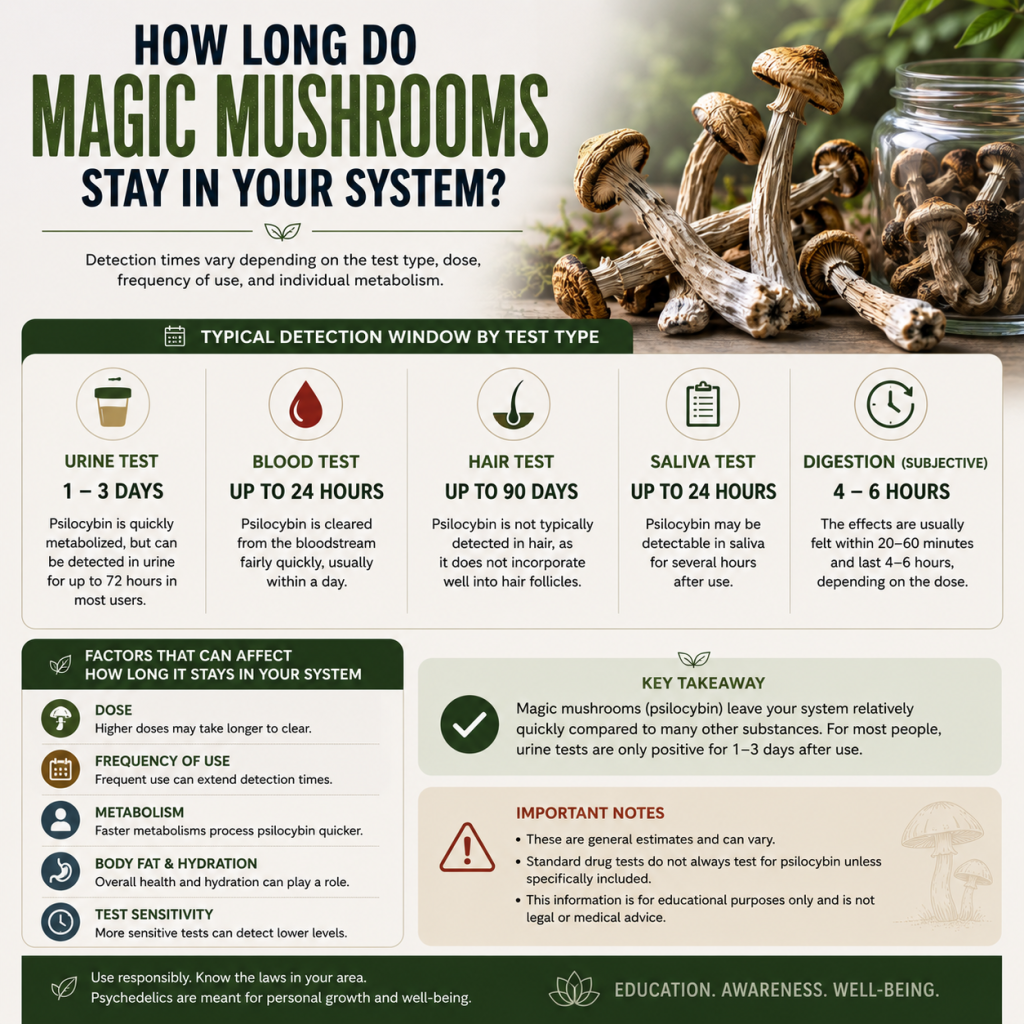
| Test type | General detection picture |
|---|---|
| Urine | Specialized testing can detect psilocin and/or metabolites, with controlled research showing measurable urinary psilocin generally declining substantially within about 24 hours. |
| Blood | The detection window is relatively short because psilocin is rapidly metabolized and is unstable in blood samples. |
| Saliva/oral fluid | There is limited evidence for a standardized routine detection window for psilocybin or psilocin. |
| Hair | There is no well-established, routinely validated detection window for psilocybin or psilocin in hair testing. |
These should be treated as scientific estimates rather than guarantees. Test sensitivity, laboratory methodology, the analyte being measured, dose, timing, and individual metabolism can all affect results.
What Happens to Psilocybin After You Consume Magic Mushrooms?
Understanding metabolism helps explain why psilocybin generally has a relatively short detection period.
Psilocybin Enters the Body
Psilocybin is a prodrug, meaning it is converted into another compound that produces the primary pharmacological effects.
After oral administration, psilocybin is rapidly dephosphorylated to psilocin. Human pharmacokinetic studies have detected psilocin in plasma within the early stages following administration, with peak concentrations occurring later as absorption and metabolism progress.
Psilocin Produces the Main Effects
Psilocin is the active compound that interacts with serotonin receptors, including the 5-HT2A receptor, producing the characteristic psychedelic effects associated with psilocybin.
It is extensively distributed throughout the body and crosses the blood-brain barrier.
The Body Metabolizes Psilocin
Psilocin is subsequently metabolized through several biochemical pathways.
Research indicates that metabolism involves enzymes including CYP2D6 and CYP3A4, while further biotransformation produces compounds such as 4-hydroxyindole-3-acetic acid (4-HIAA) and conjugated forms of psilocin.
A substantial proportion of psilocin is converted into conjugated metabolites, particularly psilocin-O-glucuronide. These metabolites are important because specialized laboratory analysis may target them rather than looking only for free psilocin.
The Metabolites Are Eliminated
The kidneys play an important role in eliminating psilocin-related compounds through urine.
In one controlled human study, urinary psilocin concentrations peaked during the 2–4-hour collection period, while the analytical limit of quantification was usually reached by approximately 24 hours. Only about 3.4% of the administered dose was recovered as free psilocin in urine.
This explains why simply asking how long “mushrooms” remain in the body can be misleading. The mushroom material itself isn’t what a specialized toxicology test necessarily measures; laboratories may instead look for psilocin and specific metabolites.
How Long Can Magic Mushrooms Be Detected in Different Drug Tests?
1. Urine Testing
Urine is one of the most commonly used specimens for drug testing.
However, standard employment urine panels generally aren’t designed to detect psilocybin. Specialized analytical methods can identify psilocin and its metabolites when specifically requested.
A controlled human study found that urinary psilocin concentrations were highest approximately 2–4 hours after administration and generally declined to the study’s quantification limit by around 24 hours. The study also demonstrated that psilocin can occur in urine in glucuronidated form, which means laboratory preparation can affect detectability.
Therefore, it is more scientifically accurate to say that specialized urine testing may detect psilocin-related compounds for roughly the first day after use, rather than claiming that every urine test will detect mushrooms for a fixed number of days.
2. Blood Testing
Blood testing generally provides a shorter detection window than many urine tests.
Psilocin appears in plasma after oral psilocybin administration and is then rapidly distributed and metabolized. Earlier pharmacokinetic research found peak plasma psilocin concentrations at approximately 105 minutes on average, while newer studies report relatively short elimination half-lives.
Blood detection is also analytically challenging because psilocin is chemically unstable. A recent forensic study found substantial degradation of psilocin in whole blood under common storage conditions, highlighting why specialized sample handling and validated analytical methods matter.
Consequently, there is no dependable universal number of hours that applies to every blood test.
3. Saliva or Oral-Fluid Testing
Saliva testing, also called oral-fluid testing, can identify certain drugs and metabolites relatively close to the time of use.
However, research establishing a standardized routine detection window specifically for psilocybin or psilocin in saliva is limited. Unlike the federally regulated drug categories routinely tested in oral fluid, psilocybin is not part of the standard federal workplace panel.
The U.S. Substance Abuse and Mental Health Services Administration (SAMHSA) explains that federal workplace testing covers specified categories including amphetamines, cocaine, marijuana, opioids, and PCP—not psilocybin.
For that reason, claims that magic mushrooms can reliably be detected in saliva for a specific number of days should be viewed skeptically unless they refer to a particular validated laboratory method.
4. Hair-Follicle Testing
Hair testing is sometimes described as having a much longer detection window than urine or blood testing because substances incorporated into growing hair can potentially remain detectable for extended periods.
However, psilocybin and psilocin do not have a well-established routine hair-testing window comparable to substances commonly included in forensic hair testing.
The available scientific literature is much more limited for hair than for blood and urine. Consequently, it would be misleading to claim that magic mushrooms are reliably detectable in hair for a specific number of months.
A specialized laboratory could theoretically investigate psilocybin-related compounds using advanced analytical techniques, but that is very different from saying that a conventional employment hair test routinely screens for them.
Do Standard 5-Panel or 10-Panel Drug Tests Detect Shrooms?
Generally, standard 5-panel employment drug tests do not screen for psilocybin or psilocin.
For example, the U.S. Department of Transportation’s regulated 5-panel test covers:
- Marijuana metabolites
- Cocaine metabolites
- Amphetamines
- Opioids
- Phencyclidine (PCP)
Psilocybin and psilocin are not among those required categories.
The current SAMHSA federal workplace-testing framework likewise specifies its authorized drug categories rather than including psilocybin.
It’s worth remembering, however, that “not included in a standard panel” does not mean “impossible to detect.” A laboratory can use specialized analytical methods when a particular substance is specifically being investigated.
A 2026 analytical-toxicology study, for example, examined methods for detecting psilocin and its glucuronide metabolite in urine, demonstrating that targeted testing is technically possible.
What Determines How Long Psilocybin Can Be Detected?
Several variables can influence pharmacokinetics and analytical detection.
Dose and Exposure
The amount consumed can affect the concentrations of psilocin and its metabolites available for measurement. However, detection doesn’t increase in a perfectly predictable manner as the dose increases.
Individual Metabolism
People differ in how quickly they absorb, distribute, metabolize, and eliminate substances. Enzyme activity, liver function, kidney function, age, and other physiological variables can contribute to differences.
Test Sensitivity
A highly sensitive laboratory method may detect extremely small quantities that a less sensitive screening method would not identify.
This is one reason that detection “windows” should never be interpreted as guarantees.
What the Laboratory Is Actually Measuring
A test looking for free psilocin is not necessarily equivalent to a test measuring total psilocin after hydrolysis of conjugated metabolites.
Research has shown that much of the psilocin eliminated in urine exists in conjugated form, particularly as psilocin-O-glucuronide.
Detection Time Is Not the Same as Effects
Another important distinction is the difference between how long the effects last and how long a compound can potentially be detected.
Psilocin has a relatively short elimination half-life, but that does not mean every trace disappears immediately. Conversely, the ability of a specialized laboratory method to identify a metabolite does not mean that a person is still experiencing psychedelic effects.
Pharmacokinetic research generally places the oral psilocin half-life in the range of a few hours, with substantial variation between studies.
Frequently Asked Questions
How long do shrooms stay in your urine?
Specialized urine analysis can detect psilocin and related metabolites, particularly during the first several hours after use. In controlled research, urinary psilocin generally declined to the analytical quantification limit by approximately 24 hours.
Can a blood test detect shrooms?
Yes, specialized blood analysis can detect psilocin-related compounds, but the window is relatively short and testing is technically challenging because psilocin is rapidly metabolized and unstable in blood.
Can a saliva test detect psilocybin?
Specialized analytical testing may be possible, but there is not a well-established routine saliva detection window for psilocybin comparable to commonly tested drugs.
Can a hair test detect magic mushrooms?
There is currently insufficient evidence to provide a reliable standard hair detection window for psilocybin or psilocin. Routine employment hair panels generally focus on other drug classes.
Will a 5-panel drug test detect mushrooms?
A standard 5-panel workplace test generally does not include psilocybin or psilocin. The federal DOT 5-panel framework covers marijuana, cocaine, amphetamines, opioids, and PCP.
Will a 10-panel test detect psilocybin?
The term “10-panel” does not describe one universal laboratory configuration. Panels can vary between employers and laboratories. Therefore, the specific analytes listed on the test should be checked rather than assuming that every 10-panel test is identical.
Related Reading
For more information about psychedelic experiences and mushroom-related topics, explore the educational resources on Organic Shrooms Canada.
You can also read What Is Psychedelic Integration for information about processing and reflecting on psychedelic experiences.
For broader mushroom-related articles, visit the site’s Blog, where you can explore additional educational content.
Final Takeaway
So, how long do magic mushrooms stay in your system?
Psilocybin is rapidly converted into psilocin, which is then extensively metabolized and eliminated. Human studies show that psilocin has a relatively short half-life, generally measured in hours rather than days. Specialized urine testing can detect psilocin and related metabolites for a limited period, while blood detection is typically shorter and more technically demanding. Evidence for standardized saliva and hair detection windows is much less established.
Most importantly, standard 5-panel employment drug tests do not include psilocybin, and a “10-panel” test isn’t necessarily standardized across laboratories. Targeted testing is different from routine workplace screening, so the exact test panel and analytical method matter.
For the most reliable information about a particular drug test, check the laboratory’s stated analytes or speak directly with the testing provider. Scientific detection windows are estimates, not guarantees.
