magic mushroms facts
What Are the Effects of Magic Mushrooms? A Complete Guide
Aug
Stepping into the world of natural entheogens often starts with a simple question: What actually happens when someone takes magic mushrooms? Whether you are reading up out of pure curiosity or considering exploring natural wellness options, understanding how psilocybin interacts with the mind and body is essential.
At their core, magic mushrooms are fungi that contain psilocybin, a naturally occurring psychedelic compound. Once ingested, this compound transforms into psilocin inside the body, triggering a cascade of perceptual, emotional, and physical shifts. If you have ever wondered about the true nature of these experiences, let us break down the effects step by step.
The Onset (How Shrooms Begin to Work)
Unlike fast-acting substances, magic mushrooms require patience. After consuming them—whether eaten raw, brewed into a tea, or taken as capsules—the digestive system has to process the material before any changes occur.
- Timeline of Onset: Typically, users begin to notice the first subtle shifts anywhere from 20 to 60 minutes after ingestion.
- Initial Sensations: Early indicators often include a light body heaviness, a sudden burst of unprovoked laughter, a shift in mood, or a slight tingling sensation in the limbs.
- The Come-Up: As psilocin binds to the brain’s serotonin receptors (specifically the 5-HT2A receptors), sensory inputs begin to sharpen. Colors might look brighter, and everyday objects can take on a shimmering, living quality.
To explore the clinical science behind how serotonin receptors process psychedelic compounds, you can read more via the National Institutes of Health (NIH).
The Peak Effects (Mind, Body, and Vision)
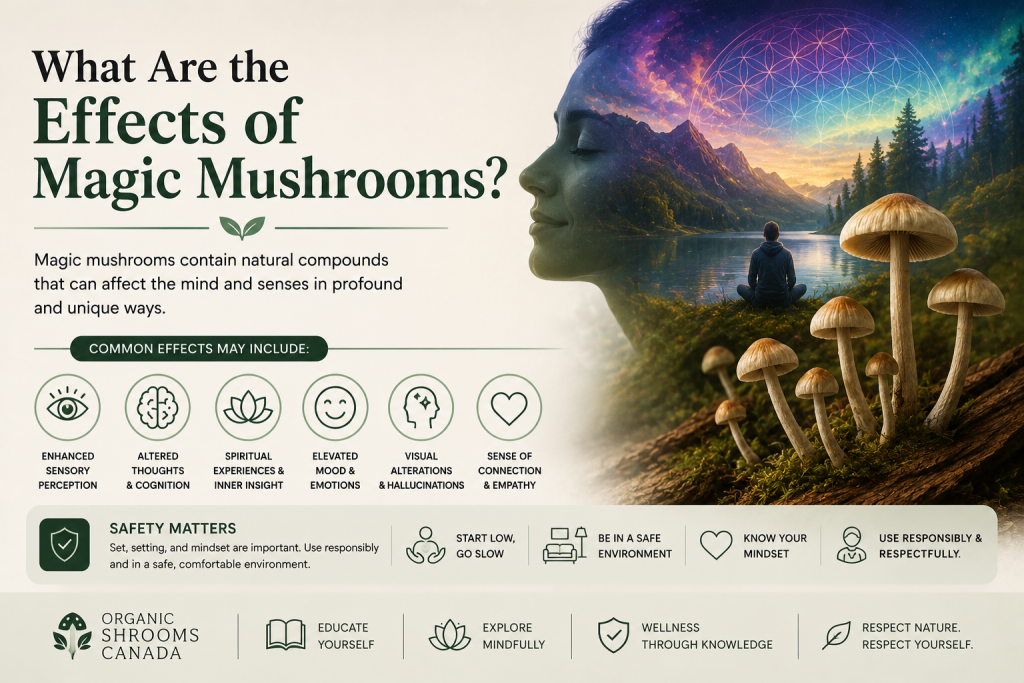
Once the journey reaches its peak—usually around the 2-to-3-hour mark—the full spectrum of magic mushroom effects unfolds. This phase is characterized by profound alterations in thought patterns, perception, and physical awareness.
Mental and Emotional Shifts
- Visual Enhancements: Users frequently report vibrant closed-eye visuals, geometric patterns, and a breathing or morphing quality in surfaces like wood grain or grass.
- Altered Time Perception: Minutes can feel like hours, and linear time often loses its rigid meaning.
- Deep Introspection and Empathy: Emotional processing intensifies. Many people experience feelings of deep interconnectedness, universal love, or a dissolving of the ego.
Physical Sensations
- Body Load: Some users experience mild physical quirks, such as slight chills, yawning, or a fleeting sense of nausea during the come-up phase.
- Dilated Pupils: Just like many other classical psychedelics, pupils naturally widen in response to shifting neurological activity.
If you are interested in exploring curated natural psilocybin varieties that offer unique cannabinoid or botanical profiles, you can browse options available through Organic Shrooms Canada. For broader educational context on how natural entheogens compare to other substances, check out resources hosted by Medical News Today.
The Offset and Afterglow (Coming Down)
The peak intensity eventually gives way to a gradual descent known as the “come-down.” This phase typically spans another hour or two, allowing the user to gently return to baseline reality.
- The Gentle Landing: Unlike synthetic stimulants that leave users jittery and exhausted, magic mushrooms usually fade away smoothly.
- The Afterglow: Many individuals report feeling a lingering sense of mental clarity, emotional reset, and lingering peace over the days following their experience.
For safety parameters, psychological integration guidelines, and modern clinical frameworks surrounding psilocybin therapy, refer to updates provided by Sunstone Therapies. Additional objective data on safety and classification can also be found through the Alcohol and Drug Foundation (ADF).
Frequently Asked Questions (FAQs)
How long do the effects of magic mushrooms last?
The entire experience typically lasts between 4 to 6 hours. The onset takes about 30 to 60 minutes, the peak occurs around the 2-hour mark, and the remaining time is spent gradually coming down and returning to baseline.
What physical side effects do shrooms cause?
Common physical side effects include dilated pupils, mild changes in heart rate or blood pressure, yawning, and occasional nausea during the initial onset. These effects naturally subside as the body processes the compound.
Can magic mushrooms cause bad trips?
Yes, challenging psychological experiences—often called “bad trips”—can happen, especially if someone is in a stressful environment, feeling anxious, or taking too high of a dose. Ensuring a safe, comfortable environment (known as “set and setting”) significantly minimizes this risk.
Are magic mushrooms addictive?
Clinical data indicates that psilocybin is not physically addictive. Furthermore, it does not cause compulsive drug-seeking behavior. The intense mental and physical nature of the experience naturally discourages frequent or casual abuse. To explore safe, natural wellness options, you can check out selection guides on Organic Shrooms Canada.
Do magic mushrooms show up on a standard drug test?
Standard employment drug panels—such as standard 5-panel or 10-panel urine tests—typically do not screen for psilocybin or psilocin. Specialized, costly laboratory tests can detect them, but they are rarely used in routine screenings.
