Uncategorized
Best Mushrooms for Depression and Anxiety: What the Science Says
Sep
Best Mushrooms for Depression and Anxiety:
Medical Disclaimer: This article is for educational and informational purposes only and is not intended to diagnose, treat, cure, or prevent depression, anxiety, or any other medical condition. Mushroom supplements and psychedelic mushrooms can affect people differently and may interact with medications or existing health conditions. If you are experiencing persistent depression, severe anxiety, suicidal thoughts, or another mental-health concern, speak with a qualified healthcare professional. Never stop taking prescribed medication without medical guidance.
Best Mushrooms for Depression and Anxiety: An Evidence-Based Guide
Depression and anxiety affect millions of people, and many are exploring nutrition, lifestyle changes, functional foods, and complementary wellness approaches alongside conventional mental-health care.
Among the natural products receiving growing attention are mushrooms.
But what are the best mushrooms for depression and anxiety?
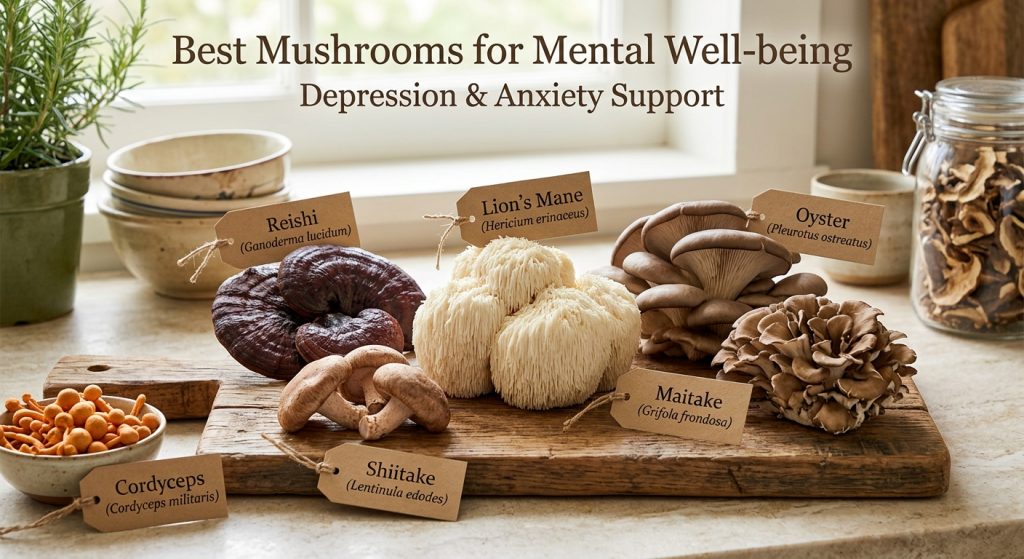
The answer depends on the type of mushroom. Functional mushrooms such as Lion’s Mane, Reishi, Cordyceps, and Chaga are non-psychedelic fungi that researchers are investigating for their potential effects on cognition, stress, inflammation, energy, and general wellbeing.
Psychedelic mushrooms are different. Certain species contain psilocybin, a psychoactive compound currently being studied for depression, anxiety, and other mental-health conditions in controlled clinical settings.
The science is promising in some areas, but it is important to separate emerging research from proven medical treatments.
What Are the Best Mushrooms for Depression and Anxiety?
There is currently no mushroom officially established as a universal treatment for depression or anxiety.
However, several mushrooms have attracted scientific and traditional interest:
- Lion’s Mane — researched for cognition, nerve growth, neuroplasticity, inflammation, and mood-related pathways.
- Reishi — traditionally associated with relaxation and general wellness and being studied for stress and sleep-related effects.
- Cordyceps — investigated for energy, fatigue, antioxidant activity, and physical performance.
- Chaga — studied primarily for antioxidant and anti-inflammatory properties.
- Psilocybin mushrooms — being investigated in clinical trials for depression and anxiety, particularly through supervised psychedelic-assisted therapy.
These mushrooms should not be treated as interchangeable.
Functional mushrooms generally do not produce psychedelic effects. Psilocybin mushrooms can significantly alter perception, mood, cognition, and consciousness and require a very different safety and legal discussion.
Functional and Medicinal Mushrooms for Mental Health
Interest in medicinal mushrooms for mental health has increased as researchers investigate connections between the brain, nervous system, inflammation, oxidative stress, and overall wellbeing.
The evidence for functional mushrooms is still developing. Some laboratory and early human studies are encouraging, but many questions remain about appropriate preparations, long-term use, dosage, and effectiveness for diagnosed mental-health conditions.
1. Lion’s Mane and Depression
Lion’s Mane (Hericium erinaceus) is probably one of the most discussed functional mushrooms in connection with brain health.
Researchers have investigated compounds found in Lion’s Mane for their potential effects on nerve growth, neuroprotection, inflammation, cognition, and neuroplasticity.
This is why the search term Lion’s Mane depression has become increasingly popular.
Some research suggests that Lion’s Mane compounds may influence biological pathways associated with nerve growth and brain function. However, laboratory findings do not automatically mean that a mushroom supplement will treat clinical depression.
Human research remains relatively limited.
Recent research has continued to investigate Lion’s Mane’s possible effects on cognition and mood, but results have not established it as a proven antidepressant.
The takeaway: Lion’s Mane is an interesting functional mushroom for brain and cognitive wellness, but more high-quality human research is needed before it can be considered a treatment for depression or anxiety.
For readers interested in mushroom wellness more broadly, explore the [Organic Shrooms Canada homepage] for additional educational resources and mushroom categories.
2. Reishi Mushroom for Stress and Relaxation
Reishi (Ganoderma lucidum) has been used traditionally in various wellness practices for centuries.
Today, researchers are examining Reishi for antioxidant, immune-modulating, anti-inflammatory, and other biological properties.
This has contributed to interest in Reishi mushroom stress relief, particularly among people looking for natural ways to support relaxation and overall wellbeing.
However, it is important not to overstate the research.
While Reishi is widely discussed in connection with stress and relaxation, there is not enough clinical evidence to conclude that Reishi treats anxiety disorders or depression.
Instead, it may be more appropriate to consider Reishi as a functional mushroom that can form part of a broader wellness routine.
3. Cordyceps for Energy and Fatigue
Cordyceps mushrooms are particularly popular among people interested in energy, endurance, and physical performance.
Researchers have examined Cordyceps for possible antioxidant effects, energy metabolism, oxygen utilization, inflammation, and exercise-related performance.
Why does this matter for mental wellbeing?
Fatigue and low energy can accompany periods of stress and low mood. Supporting general physical wellbeing may therefore be helpful for some people.
However, Cordyceps should not be considered a treatment for depression.
Persistent fatigue can have many causes, including sleep problems, nutritional deficiencies, medication effects, depression, and other health conditions. If fatigue is severe or persistent, professional medical evaluation is more appropriate than simply relying on supplements.
4. Chaga and Antioxidant Support
Chaga (Inonotus obliquus) is another functional mushroom known for its naturally occurring compounds with antioxidant potential.
Oxidative stress and inflammation are areas of interest in neuroscience and mental-health research. However, this does not mean that consuming Chaga has been proven to prevent or treat depression or anxiety.
Compared with the growing clinical literature around psilocybin, direct human research connecting Chaga with depression and anxiety is much more limited.
Chaga is therefore better understood as a general wellness mushroom, rather than a direct mental-health treatment.
Psychedelic Mushrooms: What About Psilocybin and Anxiety?
Psychedelic mushrooms represent a completely different category.
Some species contain psilocybin, a naturally occurring psychedelic compound. After ingestion, psilocybin is converted into psilocin, which interacts primarily with serotonin receptors, particularly the 5-HT2A receptor.
Researchers believe these interactions may temporarily change communication between brain networks and contribute to changes in perception, cognition, emotion, and psychological flexibility.
This is why psilocybin and anxiety has become an important area of modern psychedelic research.
What Does Research Say About Psilocybin and Depression?
Clinical research has produced promising findings.
A systematic review and meta-analysis of clinical trials found evidence that psilocybin may reduce depression and anxiety symptoms in people experiencing psychological distress associated with life-threatening illnesses.
More recent meta-analyses have also reported significant reductions in depressive symptoms following psilocybin treatment compared with comparator interventions. One 2025 meta-analysis of randomized controlled trials included 427 participants and found antidepressant effects favoring psilocybin-assisted therapy, while also identifying increased risks of some adverse effects such as headache and dizziness.
Another systematic review and meta-analysis found a significant benefit of psilocybin on depression scores compared with comparator treatments.
These findings are encouraging, but they do not mean that taking psychedelic mushrooms independently is equivalent to participating in a clinical treatment.
Psilocybin and Neuroplasticity
One reason researchers are interested in psilocybin is its potential relationship with neuroplasticity.
Neuroplasticity refers to the brain’s ability to change its structure and patterns of communication in response to experiences.
Researchers are investigating whether psychedelic compounds can temporarily increase forms of neural flexibility and alter communication between brain networks.
Psilocybin’s primary activity at serotonin 5-HT2A receptors is considered an important part of its mechanism, although the complete therapeutic mechanism remains under investigation.
Terms such as “rewiring the brain” and “growing new brain cells” are sometimes used too casually online. Current research does not justify presenting those claims as established facts for every person who consumes psilocybin.
Psilocybin and Treatment-Resistant Depression
Treatment-resistant depression is another important area of psychedelic research.
Some studies have investigated psilocybin-assisted therapy in people whose depression has not responded adequately to conventional treatments.
A systematic review and meta-analysis published in 2023 included randomized and open-label studies involving depression and reported a substantial overall effect favoring psilocybin.
Research published more recently has continued to investigate treatment-resistant depression, optimal treatment protocols, patient selection, psychological support, and safety.
The important point is that promising research does not mean psilocybin is a universally appropriate treatment.
Clinical studies typically involve:
- Careful participant screening
- Controlled doses
- Professional supervision
- Psychological preparation
- Monitoring during the experience
- Follow-up and psychological support
That environment is very different from unsupervised use.
Is Psilocybin Legal in Canada?
Canadian readers should pay particular attention to the legal situation.
According to Health Canada, the production, sale, and possession of magic mushrooms containing psilocybin are illegal in Canada unless specifically authorized.
Health Canada also states that there are currently no approved therapeutic products containing psilocybin in Canada. However, legal pathways can exist in certain circumstances, including authorized clinical trials, the Special Access Program, and specific exemptions.
For current Canadian regulatory information, consult Health Canada’s official information on psilocybin and magic mushrooms.
This distinction is important because scientific research and legal availability are two separate issues.
Functional Mushrooms vs. Psilocybin Mushrooms
| Mushroom | Main area of interest | Psychedelic? | Evidence for depression/anxiety |
|---|---|---|---|
| Lion’s Mane | Cognition, nerve growth, neuroplasticity | No | Early and promising |
| Reishi | Relaxation, stress and general wellness | No | Limited |
| Cordyceps | Energy and fatigue | No | Limited direct evidence |
| Chaga | Antioxidant and general wellness research | No | Very limited direct evidence |
| Psilocybin mushrooms | Depression, anxiety and psychedelic-assisted therapy | Yes | Promising clinical evidence |
The biggest takeaway is that not all mushrooms marketed for wellness have the same evidence or effects.
How to Incorporate Functional Mushrooms Safely
Functional mushrooms are commonly available in several forms.
Mushroom Powders
Powders can be mixed into foods, smoothies, coffee, or other beverages.
Always follow the manufacturer’s directions and check the ingredient label carefully.
Capsules
Capsules can provide a convenient option for people who prefer a measured supplement format.
Look for transparent labeling that identifies the mushroom species and other ingredients.
Mushroom Teas
Mushroom preparations can also be incorporated into beverages.
If you’re researching mushroom tea, explore our existing [How to Make Shroom Tea] article for additional educational information.
Keep in mind that preparations containing psilocybin are legally and pharmacologically different from ordinary functional mushroom teas.
Mushroom Products and Categories
If you’re exploring non-psychedelic mushroom wellness products, you can browse the [Mushroom Edibles category] on Organic Shrooms Canada.
Readers interested in microdosing-related education can also visit the [Microdosing category].
For broader mushroom products and information, visit the [Magic Mushrooms category].
What Should You Look for in a Mushroom Supplement?
Not every mushroom product is identical.
Before purchasing a functional mushroom supplement, consider:
- The exact mushroom species.
- Whether the product contains fruiting bodies, mycelium, or both.
- The extraction method.
- Ingredient transparency.
- Manufacturing and quality-control information.
- Third-party testing where available.
- Serving-size information.
- Potential allergens and additional ingredients.
Avoid assuming that a higher concentration automatically means a better product.
“Natural” also does not automatically mean “risk-free.”
When Should You Talk to a Healthcare Professional?
Anyone experiencing persistent depression, severe anxiety, significant sleep disruption, or unexplained changes in mood should consider speaking with a qualified healthcare professional.
Professional guidance is particularly important if you:
- Take prescription medications.
- Have an existing psychiatric condition.
- Have cardiovascular problems.
- Are pregnant or breastfeeding.
- Have experienced severe reactions to supplements.
- Are considering psychedelic substances.
- Have thoughts of self-harm or suicide.
Health Canada notes that magic mushrooms can cause anxiety, fear, nausea, increased heart rate and blood pressure, altered perception, and other adverse effects. It also highlights potentially increased risks for people with certain psychiatric or cardiovascular conditions.
Frequently Asked Questions
What is the best mushroom for depression?
There is no mushroom scientifically established as the best treatment for depression. Lion’s Mane has attracted considerable research attention because of its potential effects on cognition, neuroplasticity, inflammation, and mood-related pathways, but more human research is needed.
Can Lion’s Mane help with anxiety?
Early research suggests that Lion’s Mane may influence pathways involved in nervous-system and brain function. However, there is currently insufficient evidence to describe Lion’s Mane as a treatment for an anxiety disorder.
Does Reishi help with stress?
Reishi has traditionally been used for general wellness and relaxation, and researchers are investigating its biological effects. However, strong clinical evidence demonstrating that Reishi directly treats anxiety or depression remains limited.
Can psilocybin help depression?
Clinical research suggests that psilocybin-assisted therapy may reduce depressive symptoms in some carefully selected patients. Several systematic reviews and meta-analyses have reported encouraging results, but research is ongoing and treatment protocols remain an active area of investigation.
Can psilocybin help anxiety?
Research suggests that psilocybin may reduce anxiety symptoms in certain clinical populations, including people experiencing psychological distress related to serious illness. However, these results come primarily from controlled research settings and should not be interpreted as evidence for unsupervised self-treatment.
Are magic mushrooms legal in Canada?
Health Canada states that the production, sale, and possession of magic mushrooms containing psilocybin are illegal in Canada unless authorized. Specific legal pathways exist for certain clinical and regulatory circumstances.
Final Thoughts: Choosing the Right Mushroom for Your Wellness Goals
The search for the best mushrooms for depression and anxiety does not have a simple one-mushroom answer.
Functional mushrooms such as Lion’s Mane, Reishi, Cordyceps, and Chaga are being studied for different aspects of health and wellness. Lion’s Mane is particularly interesting in research involving cognition and neuroplasticity, while Reishi is traditionally associated with relaxation and general wellbeing.
Psilocybin mushrooms are different. Clinical research has produced increasingly encouraging evidence for psilocybin-assisted therapy in depression and anxiety, including research involving treatment-resistant depression. However, the therapy studied in clinical trials involves careful screening, controlled administration, professional support, and follow-up.
For Canadian readers, legal restrictions also remain important. Health Canada currently states that psilocybin-containing magic mushrooms are illegal to produce, sell, or possess unless specifically authorized.
Ultimately, mushrooms may be worth exploring as part of a broader conversation about nutrition and wellness, but they should not replace professional mental-health care.
If you want to continue learning, visit the [Organic Shrooms Canada Blog], explore our [Magic Mushrooms category], browse [Mushroom Edibles], or learn more about [Microdosing].
You can also read our existing guide on [How to Make Shroom Tea] and our article about [How Long Do Magic Mushrooms Stay in Your System?].
For additional scientific information, readers can explore PubMed’s psilocybin research database and Health Canada’s official psilocybin information.
Have you explored functional mushrooms as part of your wellness routine? Share your questions or experiences in the comments below, and explore more mushroom-wellness articles from Organic Shrooms Canada.
