magic mushroms facts
Golden Teacher Magic Mushrooms
Aug
Golden Teacher Magic Mushrooms: A Complete Educational Guide
To buy Golden Teacher magic mushrooms understands that it rank among the best-known varieties associated with Psilocybe cubensis. This species naturally produces the psychedelic compounds psilocybin and psilocin. Because of their distinctive appearance and long history within mushroom culture, Golden Teacher mushrooms continue to attract attention from researchers, educators, and people interested in psychedelic science.
However, understanding Golden Teacher requires more than recognizing its name. Readers often have questions about its appearance, classification, effects, scientific background, safety, and legal status. This guide explores those topics while separating established information from claims that lack strong scientific support.
What Are Golden Teacher Magic Mushrooms?
Golden Teacher generally refers to a cultivated variety associated with Psilocybe cubensis. Unlike the name of a scientific species, Golden Teacher describes a particular cultivated lineage that people commonly discuss within mushroom communities.
Psilocybe cubensis produces psilocybin and psilocin naturally. After the body processes psilocybin, it converts the compound into psilocin. Researchers then study how psilocin interacts with serotonin receptors in the brain.
For readers who want to start with the basics, our What Are Magic Mushrooms? guide explains the science and terminology in greater detail.
What Do Golden Teacher Mushrooms Look Like?
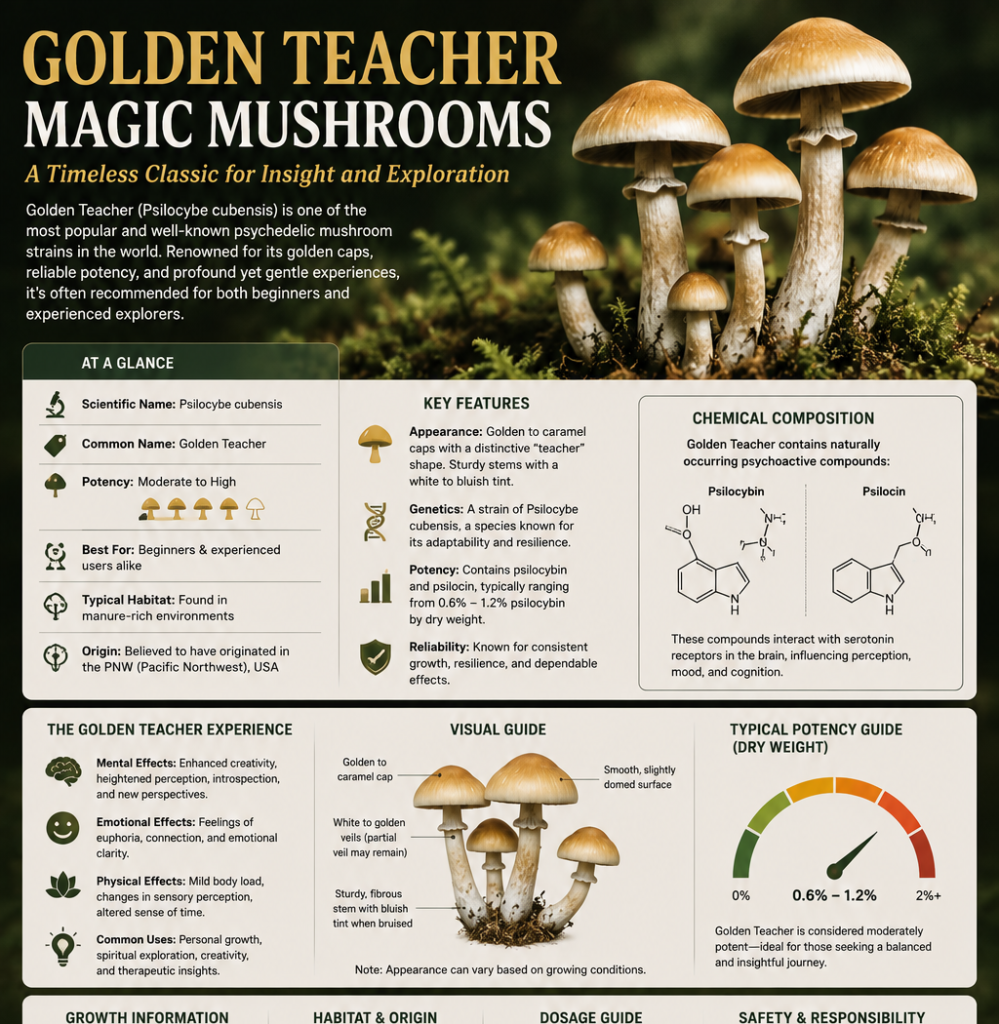
Golden Teacher mushrooms have several recognizable physical characteristics.
Golden-Colored Caps
The caps typically display golden, yellow, or yellow-brown shades. Their appearance can change as the mushroom develops and depending on environmental conditions.
Pale Stems
The stems usually appear pale or whitish. Their thickness and length can vary between individual mushrooms.
Variable Size and Shape
Individual specimens can look quite different. Genetics, environmental conditions, maturity, and available nutrients can all influence their appearance.
Bluish Discoloration
Psilocybin-containing mushrooms can develop blue or blue-green discoloration after tissue damage. Nevertheless, this characteristic does not provide a reliable method for identifying an unknown mushroom.
Therefore, anyone researching wild mushrooms should avoid identifying a specimen based solely on color or appearance.
Golden Teacher and Psilocybe cubensis
Understanding the difference between Golden Teacher and Psilocybe cubensis can prevent considerable confusion.
Psilocybe cubensis represents the scientific species. Golden Teacher, on the other hand, commonly refers to a cultivated variety associated with that species.
Other commonly discussed P. cubensis varieties include:
- B+
- Penis Envy
- Albino Penis Envy
- Jack Frost
- Tidal Wave
- Mazatapec
These names do not necessarily represent separate mushroom species. Instead, they generally describe different cultivated lineages or varieties.
Our Types of Magic Mushrooms guide provides a broader overview of psilocybin-containing species and commonly discussed varieties.
What Compounds Do Golden Teacher Mushrooms Contain?
Golden Teacher belongs to the Psilocybe cubensis group, which naturally produces psilocybin and psilocin.
The body converts psilocybin into psilocin. In turn, psilocin interacts with serotonin receptors, particularly the 5-HT2A receptor. Researchers associate this interaction with changes in perception, cognition, mood, and sensory processing.
However, the concentration of these compounds can vary significantly between individual mushrooms. Genetics, environmental conditions, maturity, and other biological factors can influence chemical composition.
As a result, readers should not assume that every Golden Teacher mushroom contains an identical concentration of psilocybin.
What Effects Does Psilocybin Produce?
Scientific research associates psilocybin with temporary changes in perception and cognition. Individual experiences can differ substantially, however.
Reported effects may include changes in:
- Visual perception
- Time perception
- Mood
- Thought patterns
- Sensory processing
- Emotional awareness
- Sense of self
Several factors can influence these experiences. For example, personal expectations, environment, psychological state, other substances, and individual biology can all play a role.
Furthermore, researchers continue to study why people can experience such different responses to the same compound.
You can learn more in our Magic Mushroom Effects guide.
Golden Teacher and Modern Psilocybin Research
Scientific interest in psilocybin has increased considerably over the past several years. Researchers now investigate the compound in controlled clinical environments for several mental health conditions.
Current research areas include:
- Depression
- Anxiety associated with serious illness
- Substance use disorders
- Obsessive-compulsive disorder
- Post-traumatic stress disorder
For example, the Johns Hopkins Center for Psychedelic and Consciousness Research conducts research into psychedelic substances, consciousness, and related therapeutic questions.
Similarly, the National Institute on Drug Abuse provides educational information about psilocybin and its effects.
Readers who want to explore peer-reviewed research can also search PubMed for scientific publications covering psilocybin, neuroscience, psychiatry, and psychedelic research.
Although some studies have produced promising findings, researchers still need additional evidence to understand long-term outcomes and potential therapeutic applications.
Golden Teacher Safety Considerations
Anyone researching Golden Teacher should understand the potential risks associated with psilocybin mushrooms.
Individual responses can vary significantly. Some people may experience anxiety, confusion, fear, or other unpleasant psychological effects.
Several factors deserve particular attention:
- Individual sensitivity varies.
- Certain psychiatric conditions may increase potential risks.
- Combining psychoactive substances can create additional risks.
- Wild mushrooms can resemble poisonous species.
- Research environments provide supervision that everyday environments may not provide.
For additional educational information, visit our Magic Mushroom Safety guide.
Why Mushroom Identification Matters
Wild mushroom identification presents another important concern. Some poisonous fungi can resemble psilocybin-containing species.
Consequently, readers should never rely solely on photographs, color, bruising, or a common name when identifying an unknown mushroom.
Are Golden Teacher Mushrooms Legal in Canada?
Canadian law places psilocybin and psilocin under federal controlled-substance regulations. However, Canadian authorities can grant specific exemptions for certain research, medical, or compassionate circumstances.
That distinction matters. A research exemption does not automatically make recreational possession or distribution legal.
Because regulations can change, readers should consult current Canadian government resources before making decisions based on legal information.
Our Magic Mushroom Legal Status guide provides additional educational information about changing regulations.
Are Golden Teacher Mushrooms Legal in the United States?
The United States has a complex legal framework surrounding psilocybin.
Federal law continues to regulate psilocybin. At the same time, some states and municipalities have adopted different approaches involving research, decriminalization, or supervised therapeutic programs.
Consequently, a law that applies in one U.S. location may not apply elsewhere.
Anyone researching the legal status of Golden Teacher should therefore check the laws that apply to their specific state and municipality.
Golden Teacher vs. Other Mushroom Varieties
People frequently compare Golden Teacher with varieties such as Penis Envy, B+, Jack Frost, and Albino Penis Envy.
However, online descriptions sometimes exaggerate differences between varieties. Scientific evidence does not support treating a variety name as a precise measurement of chemical composition or predictable effects.
Instead, researchers recognize that genetics, growing conditions, maturity, and individual mushroom variation can influence chemical content.
For that reason, readers should approach claims about guaranteed potency or identical experiences with caution.
Common Mistakes When Researching Golden Teacher
Treating the Name as a Potency Guarantee
A variety name does not guarantee a specific concentration of psilocybin. Individual mushrooms can vary considerably.
Confusing a Species With a Variety
Psilocybe cubensis identifies the species, while Golden Teacher commonly identifies a cultivated variety associated with that species.
Using Photographs to Identify Wild Mushrooms
Photographs cannot reliably distinguish every poisonous mushroom from every psilocybin-containing species.
Assuming Laws Remain the Same
Drug regulations can change over time. A rule that applied several years ago may no longer apply today.
Treating Personal Stories as Scientific Evidence
Online experiences can provide interesting perspectives. Nevertheless, personal anecdotes cannot replace controlled scientific research.
Expert Tips for Researching Golden Teacher
A few simple habits can make your research more reliable.
First, distinguish scientific names from common variety names.
Next, check reputable scientific sources before accepting claims about effects or medical applications.
Additionally, verify legal information through official government sources rather than relying on social media posts.
Finally, remember that ongoing clinical research does not automatically establish psilocybin as an approved treatment.
Frequently Asked Questions
What are Golden Teacher magic mushrooms?
Golden Teacher is a commonly recognized cultivated variety associated with Psilocybe cubensis, a species that naturally produces psilocybin and psilocin.
Why are they called Golden Teacher?
The name relates to the variety’s distinctive golden-colored appearance and its long-standing recognition within mushroom culture.
Are Golden Teacher mushrooms a species?
No. Golden Teacher generally refers to a cultivated variety associated with Psilocybe cubensis. The scientific species name is Psilocybe cubensis.
Do Golden Teacher mushrooms contain psilocybin?
Golden Teacher is associated with Psilocybe cubensis, which naturally produces psilocybin and psilocin.
Are Golden Teacher mushrooms legal in Canada?
Canadian law controls psilocybin and psilocin, although authorities can provide specific exemptions in certain circumstances. Always check current Canadian regulations.
Are Golden Teacher mushrooms legal in the United States?
Federal law regulates psilocybin, while some states and municipalities have adopted different policies. Local regulations therefore matter.
Conclusion
Golden Teacher magic mushrooms remain one of the most recognizable varieties associated with Psilocybe cubensis. Their distinctive appearance and connection to psilocybin have made them a frequent subject of mushroom education and psychedelic research.
Understanding the difference between a species and a cultivated variety provides a useful starting point. From there, readers can explore the science behind psilocybin, potential effects, safety considerations, and changing legal frameworks.
For more educational information, explore our Psilocybin Research, Magic Mushroom Safety, and Types of Magic Mushrooms guides.
