Uncategorized
Are Magic Mushrooms Legal?
Aug
Are Magic Mushrooms Legal? A Country-by-Country Guide to Psilocybin Laws
Interest in magic mushrooms has grown rapidly in recent years as scientific research into psilocybin continues to expand. As more people learn about the potential therapeutic applications of psilocybin, one of the most common questions they ask is: Are magic mushrooms legal
The answer is not straightforward. Magic mushroom laws differ significantly from one country to another and, in some places, even between states, provinces, or municipalities. Some jurisdictions permit limited medical or research use, while others continue to prohibit possession, cultivation, or distribution.
This guide explains the legal status of magic mushrooms, why laws differ across regions, how regulations continue to evolve, and what you should know before relying on legal information. Whether you’re researching psilocybin for educational purposes or simply curious about current legislation, this article provides an evidence-based overview to help you stay informed.
Are Magic Mushrooms Legal?
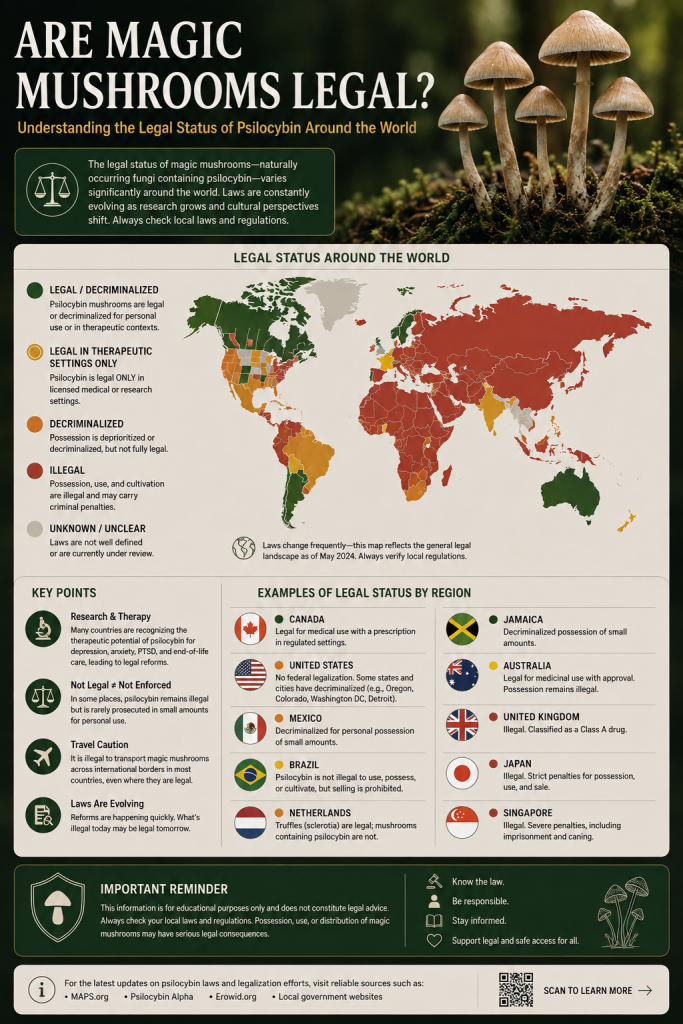
In short, there is no single global answer to the question, “Are magic mushrooms legal?” The legal status of psilocybin-containing mushrooms depends entirely on the country, state, province, or local jurisdiction.
Some regions allow limited medical research or therapeutic programs involving psilocybin under strict supervision. Others have decriminalized possession in certain circumstances, while many continue to classify psilocybin as a controlled substance.
Because laws are continually changing, it is essential to consult official government sources for the most current legal information.
If you’re new to this topic, begin with our Introduction to Magic Mushrooms and What Are Magic Mushrooms? guides to understand the basics before exploring legal considerations.
Why Do Magic Mushroom Laws Differs
Countries regulate controlled substances using different legal frameworks, public health policies, and scientific evidence.
Several factors influence legislation, including:
- Public health priorities
- Scientific and clinical research
- Historical drug policies
- International treaties
- Medical evidence
- Government regulations
As new research emerges, lawmakers in some jurisdictions continue to review existing regulations.
According to the World Health Organization (WHO), governments develop drug policies based on a combination of scientific evidence, public health considerations, and international agreements. Likewise, educational resources from the National Institute on Drug Abuse (NIDA) explain how regulations surrounding psilocybin have evolved alongside ongoing scientific research.
Current Legal Status Around the World
Although regulations continue to change, the following provides a general overview.
Canada
Canada allows approved clinical research involving psilocybin and has created limited pathways for certain exemptions and regulated medical access in specific circumstances. Recreational laws differ from research and medical programs.
Readers interested in learning more about Canadian mushroom education can explore our Magic Mushrooms Canada and Psilocybin Research guides.
United States
The United States does not have a single nationwide policy regarding magic mushrooms.
While federal law continues to regulate psilocybin, some states and municipalities have introduced decriminalization measures or supervised therapeutic programs.
Examples include:
- Oregon
- Colorado
- Certain local municipalities
Because regulations vary widely, always verify the laws that apply in your specific location
Europe
European countries regulate psilocybin differently.
Some countries maintain strict prohibitions, while others allow limited scientific research or have different rules regarding fresh mushrooms, spores, or cultivation.
Travelers should never assume regulations are the same across European borders.
Australia
Australia has updated regulations regarding certain therapeutic uses of psilocybin under tightly controlled medical circumstances. Access remains limited and occurs only through authorized healthcare pathways.
Other Countries
Legal frameworks continue to evolve worldwide.
Some countries maintain strict prohibitions, while others permit research, medical exemptions, or limited decriminalization initiatives.
Because legislative changes occur regularly, official government publications remain the most reliable source of legal information.
How to Find Accurate Legal Information
Because regulations can change without much notice, it’s important to verify information using authoritative sources.
Check Government Websites
Government health departments and justice agencies provide the most up-to-date legal information for your jurisdiction.
Review Official Public Health Resources
Organizations such as the National Institute on Drug Abuse (NIDA) publish educational information explaining current research and regulatory developments.
Read Peer-Reviewed Scientific Research
Databases such as PubMed provide access to thousands of scientific publications examining psilocybin, neuroscience, and mental health research.
Follow Reputable Research Institutions
The Johns Hopkins Center for Psychedelic and Consciousness Research continues to publish influential studies exploring psilocybin in carefully controlled clinical settings.
Why Are Laws Changing
Scientific understanding of psilocybin has grown considerably during the past two decades.
Researchers are currently studying potential applications involving:
- Depression
- Anxiety associated with serious illness
- Substance use disorders
- Obsessive-compulsive disorder (OCD)
- Post-traumatic stress disorder (PTSD)
Although research has produced promising findings, scientists emphasize that ongoing clinical studies do not automatically change existing laws or establish approved treatments outside regulated healthcare settings.
Learn more in our Psilocybin Research and How Psilocybin Works guides.
Important Considerations
When researching magic mushroom laws, remember the following:
- Laws vary by country, state, province, and municipality.
- Regulations can change at any time.
- Medical research does not necessarily indicate legal recreational use.
- Decriminalization is not the same as legalization.
- Clinical research takes place under carefully controlled conditions.
Understanding these distinctions helps prevent misunderstandings about current legal frameworks.
Common Mistakes to Avoid
Many people unintentionally misunderstand magic mushroom laws. Here are some of the most common mistakes:
Assuming Laws Are the Same Everywhere
Legal status differs significantly between jurisdictions.
Confusing Decriminalization With Legalization
Decriminalization generally reduces or changes criminal penalties but does not necessarily make an activity legal.
Relying on Outdated Information
Laws evolve regularly. Always verify information using official government resources.
Trusting Social Media Over Scientific Sources
Online discussions may not reflect current legislation or scientific evidence.
Expert Tips
- Always verify laws before traveling internationally.
- Follow updates from official government agencies.
- Read peer-reviewed research rather than relying solely on blogs or forums.
- Understand the difference between medical research, decriminalization, and legalization.
- Stay informed through respected scientific organizations.
Internal Resources You May Find Helpful
Continue learning with these educational guides on Organic Shrooms Canada:
Internal Resources You May Find Helpful
- Introduction to Magic Mushrooms
- What Are Magic Mushrooms?
- Types of Magic Mushrooms
- How Psilocybin Works
- Magic Mushroom Safety
- Psilocybin Research
- Magic Mushroom Effects
- External Resources
- National Institute on Drug Abuse (NIDA)
- Johns Hopkins Center for Psychedelic and Consciousness Research
- PubMed
- World Health Organization (WHO)
Frequently Asked Questions
Are magic mushrooms legal in Canada?
Canada permits certain research and limited medical pathways involving psilocybin under specific regulatory conditions. Recreational legality differs from medical and research access.
Are magic mushrooms legal in the United States?
Federal law regulates psilocybin, although some states and municipalities have introduced different policies, including decriminalization or supervised therapeutic programs.
Does decriminalization mean legalization?
No. Decriminalization and legalization are different legal concepts with different implications.
Why are governments reviewing psilocybin laws?
Growing scientific research has encouraged policymakers in some jurisdictions to re-evaluate existing regulations.
Where can I find reliable legal information?
Official government websites, public health agencies, peer-reviewed research available through PubMed, and research institutions such as Johns Hopkins provide reliable information.
Conclusion
The answer to “Are magic mushrooms legal?” depends entirely on where you live or travel. Legal frameworks vary widely across the world, and regulations continue to evolve as scientific research expands. While some jurisdictions have introduced medical programs, decriminalization measures, or supervised therapeutic access, others continue to prohibit psilocybin-containing mushrooms. The best way to stay informed is to consult official government sources, follow reputable scientific organizations, and understand the important distinction between research, decriminalization, and legalization.
